
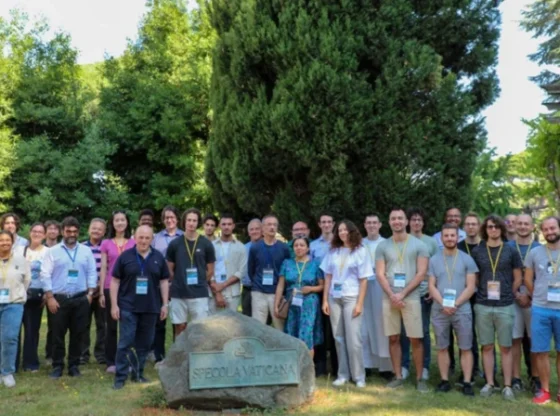

Last week, at the Vatican Observatory in Castel Gandolfo, a gathering of physicists and doctoral students convened not to pray, but to wrestle with one of the most stubborn mysteries in the cosmos: quantum gravity. The annual Vatican Observatory Lectures brought together experts including Professor Claus Kiefer of the University of Cologne to address the mathematical rupture between quantum mechanics and Einstein’s general relativity. This is not merely a technical puzzle for laboratory coats; it is a spiritual question about the nature of reality itself.
The rift is profound. Quantum mechanics governs the invisible dance of particles with breathtaking precision, while general relativity describes gravity as the curvature of space-time on a cosmic scale. Yet when scientists try to apply both simultaneously, the mathematics collapses into infinite contradictions. As the lectures revealed, the so-called “perturbative non-renormalizability” of gravity means that infinite corrections multiply without limit, rendering the theory unviable. For the spiritual seeker, this breakdown mirrors an ancient truth: the whole cannot be grasped by dividing it into parts. The universe resists being boxed into separate compartments.
This tension echoes the wisdom of the great contemplative traditions. The Christian mystic Meister Eckhart taught that God is not found in this or that attribute, but in the undivided unity beyond all categories. Similarly, the Hindu Upanishads speak of Brahman as the indivisible ground of being that cannot be captured by any single description. The struggle to unify quantum mechanics and relativity reflects a spiritual longing to see reality as a seamless whole—a quest that the great mystics undertook through silence and meditation rather than equations. The Vatican Observatory, by hosting this dialogue, reminds us that science and spirituality share a common root: the desire to touch the one fabric beneath all appearances.
What does this mean for the reader seeking wisdom? The failure of renormalization in gravity is not a failure of the human mind, but an invitation to humility. It suggests that the deepest layers of existence may not yield to calculation alone. The physicists at Castel Gandolfo are grappling with the limits of language and logic—a boundary that every contemplative knows well. The takeaway is this: the cosmos is not a machine to be dismantled, but a mystery to be approached with reverence. Whether through a telescope or a prayer, the call is the same—to let go of our need to control and to open ourselves to the infinite that cannot be fully named.