
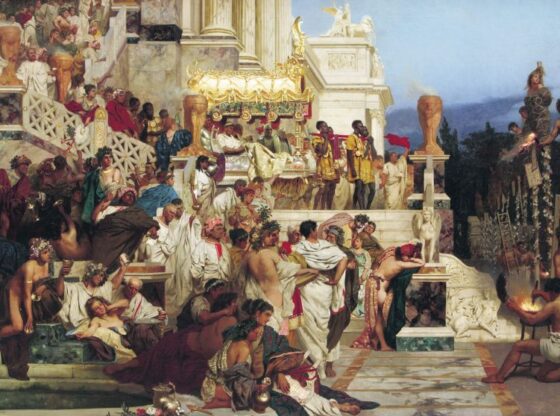

In the year 64 AD, a fire of suspicious origin ravaged Rome, reducing much of the city to ash. The Emperor Nero, desperate to deflect blame, turned his gaze upon a small and misunderstood religious community—the followers of Christ. What followed was not merely a persecution but a spectacle of cruelty designed to extinguish a fledgling faith. Yet, in the twisted logic of the spiritual world, the flames that consumed these first martyrs became the very fire that spread the Gospel across the empire. The “proto-martyrs” of Rome, as they are now known, were put to death in Nero’s circus—crucified, fed to wild beasts, and even lit as human torches to illuminate the emperor’s gardens. Their deaths were meant to be a warning; instead, they became an invitation.
Why does this matter for the soul today? Because the witness of these early Christians reveals a profound spiritual truth: that the light of faith shines brightest when surrounded by the deepest darkness. These were not trained theologians or seasoned apostles; they were ordinary men and women, called the “disciples of the apostles,” who had only recently encountered the risen Christ through the preaching of Peter and Paul. Yet in their final moments, they chose to face unspeakable horror with a peace that the world could not understand. This peace, born of an unshakeable hope in the resurrection, is the same peace that has sustained mystics, saints, and seekers across every wisdom tradition—the knowledge that death is not the end, but a doorway.
The deeper context here is not merely historical but archetypal. In the spiritual traditions of the world, from the Christian desert fathers to the Buddhist concept of impermanence, the martyr is one who has died to the self before the body ever stops breathing. The Roman proto-martyrs embodied this teaching: they had already surrendered attachment to safety, reputation, and life itself. Their deaths were not a tragedy but a fulfillment. As the great spiritual writer Thomas Merton once reflected, martyrdom is the ultimate act of letting go—a total trust that the God who holds the universe also holds each soul in the palm of His hand. The site where many of them died, now marked by the Piazza dei Protomartiri Romani in the Vatican, stands as a silent reminder that the ground of surrender is always holy.
For the modern reader, the takeaway is both challenging and liberating. We may never face a lion in the arena, but we are daily invited to die to the fears and false identities that keep us from living fully. The proto-martyrs teach us that courage is not the absence of fear, but the choice to act from a deeper place within—a place anchored in the eternal. Their witness calls us to examine our own lives: What are we holding onto that prevents us from trusting the divine? Where are we allowing the fire of transformation to be avoided rather than embraced? In a world that often seems to burn with chaos, the first holy martyrs remind us that the same fire that destroys can also purify, and that the darkest night always gives way to the dawn of resurrection.