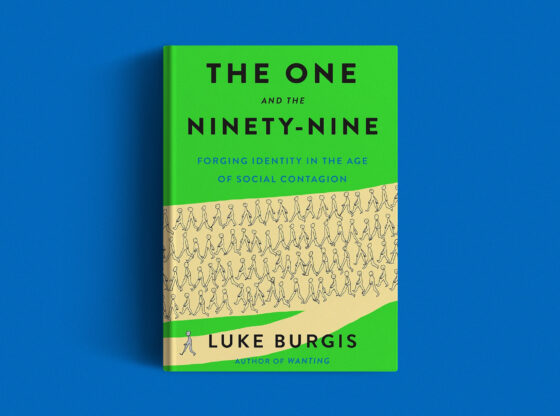

In an age where influencers hawk not just products but entire ways of being, a new book by author and entrepreneur Luke Burgis is probing the spiritual roots of modern discontent. Titled after the concept of “social contagion,” Burgis’s work, reviewed recently by Christianity Today, argues that the self-help industry—despite its promises of authentic transformation—often deepens our enslavement to borrowed desires. For the spiritual seeker in 2026, this is not merely a critique of marketing; it is an urgent call to examine the soul’s true north.
The core of Burgis’s argument draws on the mimetic theory of French philosopher René Girard, who posited that human beings are fundamentally imitative creatures. We do not know what we want until we see it in another. Burgis applies this to the self-help genre, noting that even our most private aspirations for success, health, or enlightenment are often shaped by the “models” we unconsciously follow—be they Instagram gurus, charismatic pastors, or corporate titans. “The culture is now extremely online and beset with influencers selling us skin cream and the good life,” the review observes, yet the spiritual danger lies in mistaking social mimicry for personal calling. The result is a striving that exhausts rather than fulfills, a race toward goals that were never ours to begin with.
From a wisdom tradition perspective, this insight echoes ancient teachings on detachment and the discernment of spirits. The Desert Fathers of early Christianity warned against the “demon of acedia,” a restlessness that masquerades as ambition. Similarly, the Buddhist concept of *tanha*—craving rooted in ignorance—describes how we chase after objects and statuses we believe will bring lasting peace, only to find ourselves caught in an endless cycle of wanting. Burgis’s work reframes this timeless struggle for a digital age: when our desires are socially contagious, the very act of “self-improvement” can become a form of spiritual bondage. The question is not *how* to achieve more, but *whose* achievement we are truly seeking.
The deeper context here is the crisis of identity in a hyper-connected world. When every scroll exposes us to another curated life, the boundary between inspiration and envy blurs. Burgis suggests that the path to freedom begins with naming our mimetic models—identifying the people and narratives that secretly shape our ambitions. For the spiritual reader, this is a form of confession. It requires the humility to admit that much of what we call “our” desire is actually borrowed. The takeaway is both sobering and liberating: we cannot outrun social contagion by simply buying a better planner or a more expensive course. Instead, we must cultivate a contemplative silence—a space where the still, small voice can speak louder than the algorithm. In that quiet, we may discover that the truest self-help is not a method but a surrender to a desire that is not our own making, but given.