
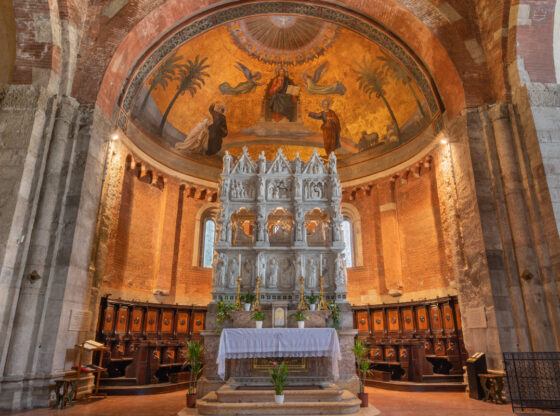

In the ancient city of Pavia, Italy, beneath the bronze-and-marble canopy of the Basilica of San Pietro in Ciel d’Oro, lies a treasure that has drawn the successors of Peter for centuries: the mortal remains of Saint Augustine of Hippo. While the secular world might view a collection of old bones as a matter for archaeologists, the repeated pilgrimages of eight Roman pontiffs to this single shrine reveal something far more profound about the spiritual architecture of the Catholic Church. This is not merely a history of visits; it is a testament to the enduring power of a single converted soul to guide the very shepherds of Christendom.
The most recent papal veneration occurred in 2022, when Pope Francis paused before the saint’s urn during a visit to Pavia. Before him came Benedict XVI in 2007, who declared Augustine “a friend of God and of men.” John Paul II made the journey in 1985, Paul VI in 1964, John XXIII in 1959, and Pius XII in 1954. Reaching further back, the historical record shows Pope Benedict VIII came in 1022, and Pope Paschal II arrived in 1107. Each pope, facing the unique challenges of their era, chose to kneel before the same stone sarcophagus. The pattern is undeniable: when the Church faces turbulence, her leaders instinctively turn to Augustine.
Why Augustine? The answer lies not in his ecclesiastical rank—he was merely a bishop of a minor North African town—but in the raw honesty of his spiritual journey. Augustine’s Confessions remain the most unflinching autobiography of the soul ever written. He knew the seduction of the flesh, the arrogance of the intellect, and the despair of a heart that cannot rest. “Our hearts are restless until they rest in You,” he wrote—a sentence that has echoed through every century since. For popes who must navigate the conflicting demands of power and humility, orthodoxy and mercy, Augustine offers a map of the interior life. He proves that sanctity is not the absence of struggle, but the transformation of struggle into love.
This phenomenon also speaks to a deeper truth about spiritual authority. In an age that often imagines religious leaders as distant figures issuing decrees from marble thrones, the popes’ pilgrimages to Pavia remind us that the Church’s greatest teachers are those who have been most profoundly taught by God. Augustine himself was a late convert, baptized at age 33 by Saint Ambrose. He spent his early adulthood chasing worldly success, fathering a son out of wedlock, and dabbling in heresy. His relics, therefore, are not trophies of a perfect life but witnesses to a redeemed one. The popes who come to Pavia are not honoring a flawless administrator; they are venerating a man who allowed grace to excavate his soul down to its foundations and rebuild it from the ground up.
For the modern seeker, the lesson is both humbling and hopeful. If the successors of Saint Peter—the very foundation of the Church—find it necessary to return again and again to Augustine’s tomb, what does that say about our own need for spiritual roots? The popes did not come to Pavia seeking a new doctrine or a political strategy. They came to stand in the presence of someone who had been utterly transformed by the love of God. In a world that offers endless self-help techniques but little lasting peace, Augustine’s relics speak a silent but thunderous truth: the only cure for restlessness is to rest in the One who made us. Whether you are a pope or a penitent, the journey is the same—and the destination is always love.