
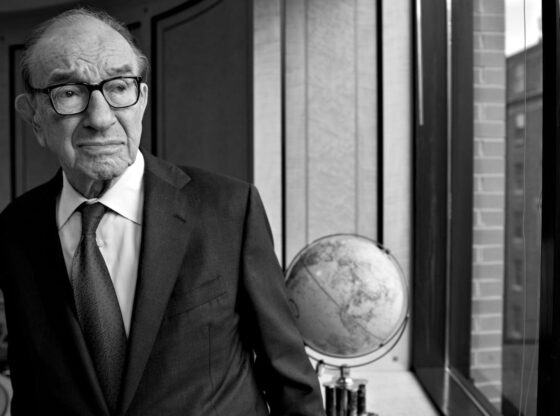

Alan Greenspan has passed at the age of one hundred, leaving behind a legacy that transcends economics and enters the realm of spiritual symbolism. For decades, he was hailed as a “Master of the Universe,” a title that echoes ancient aspirations to divine power. Yet, from a spiritual perspective, his life offers a profound lesson on the dangers of placing ultimate trust in human systems of control. The Atlantean Tribune examines what his career reveals about the modern soul’s search for security.
Greenspan’s tenure as chairman of the Federal Reserve from 1987 to 2006 was not merely a technical achievement; it was a liturgical performance. Central banking, under his stewardship, became a high priesthood of liberalism, promising to manage the cycles of boom and bust through scientific precision. This mirrors a deep spiritual yearning: the desire for a stable, predictable world free from the chaos of nature and divine mystery. In many wisdom traditions, the attempt to master uncertainty through sheer intellect is seen as a form of hubris, a forgetting that true security comes from alignment with a higher order, not from human manipulation.
The creation of the Nobel Prize in Economics in 1968, as documented by Offer and Söderberg, was a deliberate effort to bestow an aura of scientific authority upon the discipline. This was a ritual of legitimization, transforming economic policy into a quasi-religious doctrine. Greenspan became the chief celebrant of this new faith, where market efficiency was treated as an infallible law. Yet, as the ancient mystics taught, no human system is immune to the law of impermanence. The financial crises that followed his era revealed the cracks in this golden idol, reminding us that all earthly temples eventually crumble.
For the spiritual seeker, Greenspan’s story is a cautionary tale about misplaced devotion. The “Greenspan put,” as it was known—the belief that the Fed would always rescue markets—fostered a culture of moral hazard and spiritual complacency. It encouraged a reliance on external saviors rather than inner transformation. The Bhagavad Gita advises acting without attachment to outcomes, a wisdom that stands in stark contrast to the obsessive management of economic destiny. Greenspan’s life invites us to ask: Where do we seek our ultimate refuge? In the fluctuating numbers of the stock exchange, or in the unchanging ground of being?
The takeaway for the reader is this: The death of a “Master of the Universe” is a call to examine our own idols. Every age has its high priests—figures who promise to deliver us from uncertainty. But true liberation comes not from mastering the external world, but from mastering the self. As you read the tributes to Greenspan, reflect on the systems you trust for your security. Are they built on the shifting sands of human expertise, or on the eternal rock of spiritual wisdom? The greatest magic is not the manipulation of money, but the discovery of the peace that passes all understanding.