
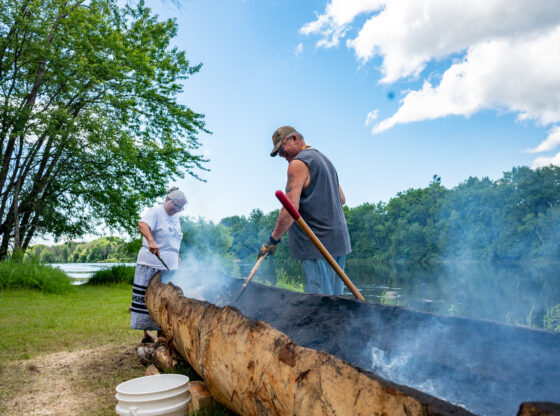

On the banks of the Menominee River in Michigan, a pine log is being transformed into a vessel of memory. Since June 15, Menominee water protectors Dawn M. Wilber and Wayne Swett have camped beside the river, burning, scraping, and sanding a 17-foot log into a traditional dugout canoe—a Maeqtek-ōs in the Menominee language. No living person can recall the last time a Menominee paddled such a craft on these waters. This week, that silence breaks. The canoe will launch for a 48-mile journey south, marking the eighth annual canoe journey of the Protectors of the Menominee River. But this year, the vessel itself carries a deeper story: the revival of a technology that once connected Woodland peoples to the flow of life itself for centuries.
This is not merely a historical reenactment. For the Menominee, the dugout canoe is a spiritual technology—a way of being in relationship with water that modern society has largely forgotten. “It’s making a statement, we’re making history,” Swett told Indian Country Today, his body bearing the heat blisters of weeks of labor. Wilber described the work as “a suffrage of sort, you know, to try to do this and bring it back to this area.” Their sore legs and sunburned arms are offerings. The canoe is not a museum piece; it is a living prayer carved from pine, donated by Menominee Tribal Enterprises, shaped by community hands. Every visitor who brings supplies or helps with the work participates in a ritual of reconnection. The canoe becomes a conduit between ancestors who paddled these rivers and a generation fighting to protect them from industrial threats.
In the spiritual traditions of Woodland peoples, water is not a resource but a relative—a living presence that carries memory, sustains life, and demands respect. The dugout canoe, hollowed from a single tree, symbolizes this relationship. Unlike modern boats that skim the surface, a dugout rides within the water, its hull carved to move with currents rather than against them. This design mirrors a deeper wisdom: that true navigation of life requires humility, not domination. The Menominee River itself has been a site of struggle against mining projects that threaten its purity. By paddling a traditional canoe, the protectors enact a form of spiritual resistance—reminding all who witness that sacred waters cannot be reduced to industrial calculations. The canoe journey becomes a pilgrimage, each stroke of the paddle a declaration of kinship with the river.
The takeaway for spiritual seekers is profound: revival is not about copying the past but embodying its wisdom in present struggles. The Menominee water protectors teach that sacred traditions are not static artifacts but living practices that must be renewed through sacrifice and community. Wilber’s words—”This year we can say (we did) in 2026″—echo across time. What ancient practice might you revive in your own life, not as nostalgia but as a way to honor the waters, lands, and ancestors that sustain you? The dugout canoe reminds us that the most radical act may be to carve out space for the sacred in a world that has forgotten how to float with grace. As the canoe glides 48 miles south, it carries not only paddlers but a prophecy: that what has been forgotten can be reborn, one blister, one prayer, one river at a time.