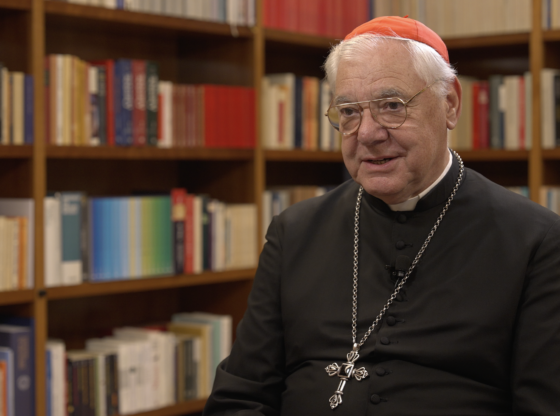

The ancient fault line of Christian authority has resurfaced with stark clarity. Cardinal Gerhard Müller, former prefect of the Dicastery for the Doctrine of the Faith, has declared that the Society of St. Pius X’s (SSPX) planned consecration of four bishops—slated for July 1 in Écône, Switzerland—constitutes a schismatic act. In an interview with EWTN News In Depth, Müller did not mince words: episcopal ordinations carried out “without the pope are absolutely impossible, against the will of God.” This is not a matter of subjective judgment, he stressed, but of “objective criteria” that define the very boundaries of Catholic communion. The consecrations, which include American Father Michael Goldade, echo Archbishop Marcel Lefebvre’s 1988 ordinations, which triggered automatic excommunication. For the faithful, this is not merely a canonical dispute; it is a spiritual crossroads where the nature of obedience, unity, and sacred tradition is being tested.
At the heart of this confrontation lies a distinction that Cardinal Müller insists upon with the precision of a dogmatic theologian: the Traditional Latin Mass (TLM) and the rejection of papal authority are “two absolutely different questions.” He affirmed the validity of the ancient liturgy and criticized bishops who forbid it as “authoritarian,” yet he drew a firm line at the act of consecrating bishops without a papal mandate. This is the spiritual core of the matter. The liturgy, however venerable, cannot become a banner for ecclesial fracture. Müller invoked the Donatists—the schism St. Augustine confronted in North Africa—as a historical mirror. The Donatists, who insisted on the purity of their ministers, ultimately broke communion over the very nature of the Church. “They should learn from the way of the Donatists,” Müller warned, noting that St. Pius X, the society’s patron, “will pray against these people who abuse his name.” The lesson is timeless: the quest for liturgical purity can, if untethered from the visible unity of the Church, become a spiritual poison.
This tension between form and authority is a recurring theme in the history of spiritual communities. The Desert Fathers taught that obedience is the chariot that carries the soul to God—not a submission to tyranny, but a surrender that heals the ego’s grip. The SSPX, in its “Declaration of Catholic Faith” sent to Pope Leo XIV and the College of Cardinals, insists that its consecrations do not break communion. Yet the Church’s ancient wisdom, from Cyprian of Carthage to Augustine, holds that the Eucharist itself is a sacrament of unity. To celebrate it apart from the bishop in communion with the Successor of Peter is to risk hollowing out the sacrament’s meaning. Cardinal Müller, himself a former prefect of the doctrine office, pointed to Pope Leo XIV—an Augustinian—as a sign of hope, implying that the current pontiff carries the very charism of the doctor of grace who defeated the Donatist heresy with both gentleness and firmness.
For the seeker of spiritual wisdom, the takeaway is not a partisan verdict but a call to interior discernment. Cardinal Müller’s counsel to the faithful drawn to SSPX Masses was direct: if a schism follows, they “shouldn’t go, and cannot participate in the Masses of schismatic priests and bishops.” This is a hard saying, but it echoes the Gospel’s insistence that unity is not optional. The soul that hungers for the sacred liturgy must ask: Can the beauty of the rite survive if it is severed from the vine of apostolic succession? The Desert tradition reminds us that the outer form is a vessel, not the source. The source is Christ, present in the Church that remains one, holy, catholic, and apostolic. The true battle is not between old and new rites, but between the spirit of humility and the spirit of separation. As Augustine wrote, “The Church is the ark of salvation; outside it, no one can be saved.” That ark is not a museum of ancient forms, but a living ship steered by the successor of Peter, through storm and calm alike.