
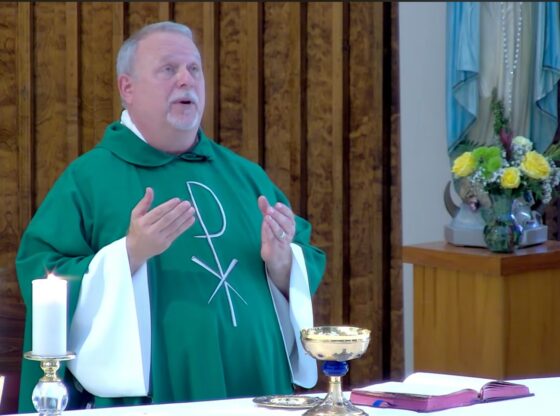

In San Antonio, Texas, a spiritual lesson unfolded in the wake of what could have been tragedy. Father Jimmy Drennan, a Catholic priest, narrowly escaped death when his rectory exploded moments after he departed to celebrate Saturday evening Mass. The blast, which occurred on March 1, 2025, completely destroyed the residence adjacent to St. Margaret Mary Catholic Church, leaving the priest to reflect on what he calls “divine timing.” Surveillance footage captured Father Drennan walking away from the building only seconds before the explosion erupted, a stark reminder of the fragile boundary between life and death.
“I’m just very grateful to God that I wasn’t in there,” Father Drennan told local media, his voice steady with gratitude. “It could have been a very different outcome.” The explosion, believed to have originated from a gas leak, leveled the rectory and damaged nearby vehicles, yet no injuries were reported. For the priest, the event transcends mere coincidence, pointing instead to a profound spiritual intervention. “I truly believe God had His hand on me,” he said, echoing a sentiment that resonates across wisdom traditions: that providence often operates in ways invisible to the human eye until catastrophe is averted.
From a spiritual perspective, this incident invites contemplation of the ancient concept of “kairos”—the Greek term for the opportune moment when divine purpose intersects with human affairs. In the Christian tradition, such moments are seen as windows into God’s sovereignty, where the ordinary sequence of time (chronos) gives way to sacred timing. Father Drennan’s escape mirrors biblical narratives like that of Daniel in the lion’s den or Paul’s survival of shipwreck, where deliverance serves not only to preserve life but to testify to a higher power at work. The rectory’s destruction, while materially devastating, becomes a canvas for reflecting on what the mystics call “the mercy of the moment”—the realization that each breath is a gift not to be taken for granted.
Deeper wisdom from Eastern and Western contemplative traditions underscores the transient nature of material existence. The rectory, built of wood and stone, was reduced to rubble in seconds, yet the priest’s life was spared. This echoes the teachings of the Buddha on impermanence (anicca) and the Christian emphasis on storing treasures in heaven rather than on earth. Father Drennan’s gratitude, expressed without bitterness, models a spiritual resilience that transforms catastrophe into an opportunity for renewal. “I’m just thankful to be alive,” he said, a simple yet profound prayer that invites readers to examine their own attachments. The takeaway for the seeker is clear: while we cannot control the circumstances of life, we can choose how we respond to them. In the ashes of the rectory, a testament to faith emerges—one that calls us to live each moment with awareness, humility, and a trust that even in destruction, there is grace.