
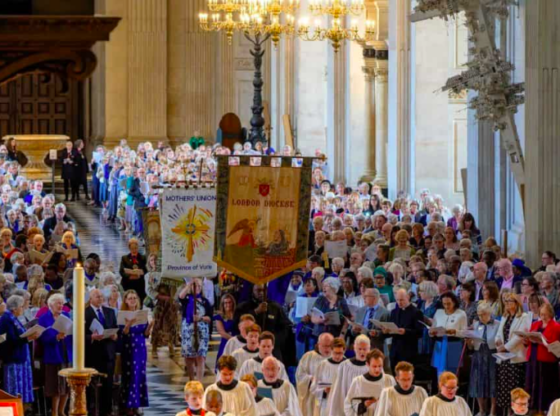

On the evening of June 10, over 1,500 members of the Mothers’ Union filled St Paul’s Cathedral in London, not merely to celebrate an anniversary, but to bear witness to a quiet revolution that has shaped the spiritual landscape of the Anglican Communion for 150 years. The gathering marked the sesquicentennial of an organization that began with a single mother’s prayer and grew into a global network of service, prayer, and advocacy. For the spiritual seeker, this milestone offers a profound lesson in how small, faithful acts can ripple outward to transform communities across generations.
What makes this anniversary spiritually significant is not the pomp of the cathedral service, but the radical nature of the Mothers’ Union’s founding vision. In 1876, Mary Sumner, a wife of a clergyman, recognized that mothers held a unique spiritual authority in the home—a power often overlooked in the formal structures of the church. She gathered a group of mothers in her parish of Old Alresford, Hampshire, to pray for their families and support one another. From that seed grew a movement that now operates in 83 countries, with over 3.5 million members. The service at St Paul’s included prayers, hymns, and a sermon that reflected on how this ministry has quietly upheld families through war, poverty, and social change, always rooted in the belief that the domestic sphere is a sacred space.
From the perspective of wisdom traditions, the Mothers’ Union embodies a truth found in many spiritual paths: that transformation often begins in the hidden, the humble, and the everyday. In Christianity, this echoes the Magnificat, where Mary proclaims that God “has brought down the powerful from their thrones and lifted up the lowly.” The Mothers’ Union took the seemingly mundane work of motherhood—nurturing, teaching, praying—and elevated it to a ministry of global reach. This aligns with the mystical tradition that sees the divine not only in cathedrals but in the kitchen, the nursery, and the community center. The organization’s emphasis on marriage, parenting, and social justice reflects a holistic spirituality that refuses to separate the sacred from the secular.
The deeper historical context reveals that the Mothers’ Union has often been a quiet force for change where institutional churches hesitated to tread. In regions where women had limited public voice, the Union provided a platform for literacy, healthcare, and economic empowerment—all framed within a spiritual calling. For example, in parts of Africa and Asia, members have run literacy programs, HIV/AIDS support groups, and domestic violence prevention initiatives, all while maintaining a rhythm of prayer and Bible study. This integration of action and contemplation offers a model for modern spirituality: that faith must be lived out in service, and service must be rooted in prayer.
The takeaway for the reader is a call to recognize the spiritual weight of everyday commitments. The Mothers’ Union’s 150-year journey reminds us that lasting impact does not require fame, wealth, or institutional power. It requires faithfulness to a simple vision, sustained over time by community and prayer. Whether you are a parent, a caregiver, or someone seeking to make a difference in your neighborhood, the lesson is clear: start where you are, with what you have, and trust that the smallest acts of love, when offered to God, can become a legacy that outlasts you. As the cathedral bells rang out over London that evening, they were not just marking a past achievement, but inviting each of us to join in the ongoing work of building a world where every family is supported, every mother honored, and every child cherished.