
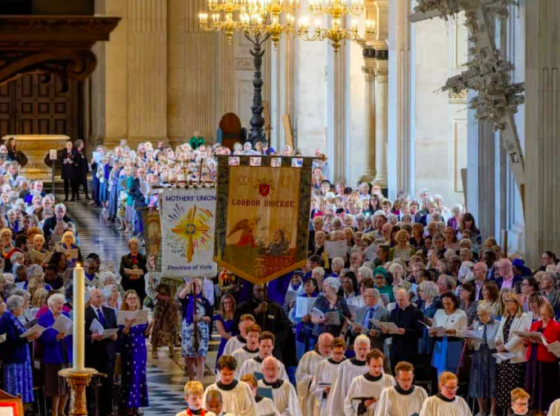

On June 10, over 1,500 members of the Mothers’ Union filled St Paul’s Cathedral in London, not merely to observe a milestone but to consecrate a living tradition. The gathering marked 150 years since Mary Sumner founded the organisation in her parish of Old Alresford, Hampshire, in 1876. What began as a small group of mothers praying together has grown into one of the Anglican Communion’s largest lay movements, active in over 80 countries. The service at St Paul’s, with its soaring dome and centuries of spiritual resonance, provided a fitting backdrop for a movement that has quietly shaped the domestic and spiritual life of millions.
The spiritual significance of this anniversary lies not in grand cathedrals or institutional power, but in the radical reclamation of the home as a site of ministry. Mary Sumner, a vicar’s wife and mother of three, saw that the Christian faith was often confined to Sunday services, while the everyday struggles of marriage, parenting, and household management were left unaddressed. She proposed that mothers—often dismissed as merely domestic figures—were in fact the primary spiritual educators of their children and the moral anchors of their communities. This was not a call to escape the home, but to sanctify it. In an age that exalts public achievement, the Mothers’ Union reminds us that the most profound spiritual work often happens in the quiet, unseen corners of family life.
Deeper wisdom traditions across the world have long recognized the sacred power of the domestic sphere. In Hinduism, the grihastha (householder) stage of life is considered essential for spiritual growth, with the home as a temple. In Buddhism, the family is a training ground for compassion and patience. The Mothers’ Union echoes this ancient insight: that the daily acts of feeding, comforting, teaching, and forgiving are not distractions from the spiritual path, but the path itself. The organisation’s emphasis on prayer, marriage preparation, and community support mirrors the monastic ideal of stability and service, but lived out in the kitchen and the nursery rather than the cloister. As one member reflected during the service, “We are not just running households; we are building the Kingdom of God, one small act of love at a time.”
For the seeker of wisdom, the 150-year journey of the Mothers’ Union offers a profound takeaway: holiness is not measured by the scale of our public achievements, but by the fidelity of our hidden commitments. In a world that often devalues the ordinary, this movement invites us to see the sacred in the mundane—the bedtime prayer, the patient listening, the meal shared in gratitude. Mary Sumner once said, “The mother’s influence is the most powerful in the world, for it is the mother who shapes the soul of the child.” Whether you are a parent, a grandparent, or simply someone seeking to infuse daily life with meaning, the lesson is clear: do not despise the small things. The quiet revolution of faith at home is where the eternal breaks into time, and where the love of God is made tangible in the simplest of gestures.