
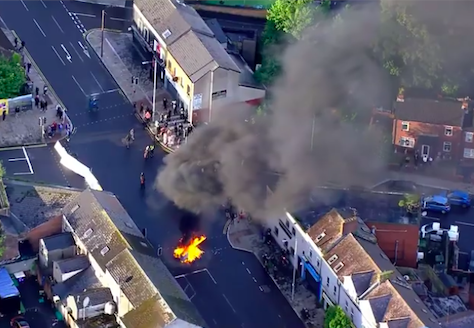

In the ancient rhythms of the Celtic soul, the sound of breaking glass and shouting crowds has once again pierced the quiet of Belfast’s streets. Following a brutal knife attack that sent shockwaves through the community, churches across the city have responded not with political statements or condemnations, but with something far more ancient: prayer. “We are heartbroken,” one local pastor told the Atlantean Tribune, his voice heavy with the weight of a city that has known too many cycles of violence. “But heartbreak is not the end. It is the beginning of turning toward the Divine.”
For the spiritual seeker, this moment in Belfast offers a profound lesson in the nature of collective trauma and redemption. The unrest is not merely a social or political crisis—it is a spiritual rupture, a tear in the fabric of community that can only be mended through what the mystics call metanoia: a transformation of the heart. The churches’ response of prayer, rather than rhetoric, echoes the wisdom of ancient prophets who understood that true peace cannot be legislated; it must be incarnated through acts of forgiveness and presence. As one elder in the city reflected, “We are not called to manage chaos. We are called to be vessels of light in the darkness.”
This pattern of violence followed by spiritual lament is as old as humanity itself. In the Celtic Christian tradition, which runs deep in Belfast’s soil, there is a practice called anam cara—the soul friend who walks with you through suffering. The churches are now acting as that soul friend for the entire city, holding space for grief without rushing to solutions. The Bhagavad Gita teaches that when the world is in turmoil, the wise do not fight fire with fire; they become the still point around which the storm revolves. Similarly, the Tao Te Ching reminds us that “violence, even well intentioned, always rebounds upon itself.” The churches’ posture of prayer is a living embodiment of this ancient wisdom: a refusal to meet hatred with hatred, and an invitation to something higher.
For readers seeking spiritual nourishment, the takeaway from Belfast’s night of unrest is both sobering and hopeful. The path to peace is not through winning arguments or suppressing anger, but through the slow, patient work of collective prayer and presence. As the Psalmist wrote, “The Lord is near to the brokenhearted and saves those who are crushed in spirit.” Belfast’s churches are not naive—they know that prayer alone will not stop a knife or heal a wound. But they also know that without the spiritual foundation of compassion and forgiveness, no political solution will ever hold. The call for each of us, wherever we are, is to become that anam cara for our own communities, holding the tension of pain without adding to it. In that sacred space, the Divine can begin to weave a new story—one not of unrest, but of resurrection.