
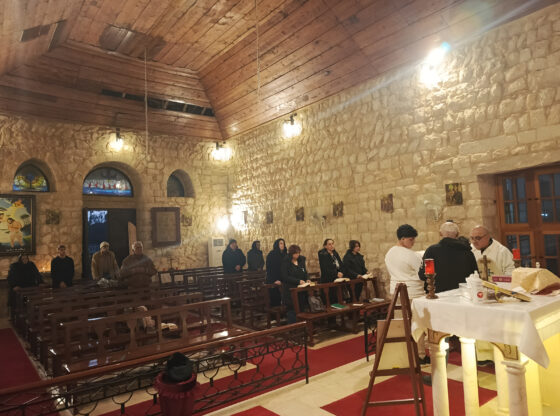

The ink on the recently announced peace deal between Israel, Iran, and the United States has barely dried, but for the Christians of southern Lebanon, the promise of cessation feels hollow. While the agreement stipulates an end to violent hostilities between Israel and Hezbollah, it simultaneously permits the Israeli military to maintain its occupation of key Lebanese territories. For communities like those in the historic Christian quarter of Tyre, this is not a return to peace, but a sentence of slow erasure. The ancient city, once a cradle of early Christian witness, now watches its faithful dwindle under the weight of occupation and fear.
This is not merely a geopolitical crisis; it is a spiritual hemorrhage. The soul of a land is being bled dry. As Melkite Greek Catholic Archbishop Georges Iskandar of Tyre recently lamented to Aid to the Church in Need, the Old Quarter of Tyre is not just a collection of ancient stones. It is a living sanctuary of faith, memory, and coexistence. “Its Old Quarter is not merely a historic area – it is a living place of faith, memory, family life, coexistence, and continuous Christian witness,” he said. “It is home to civilians, elderly people, children, and families who have remained attached to their ancestral land despite immense suffering, uncertainty, and danger.” When a living church is reduced to a relic, the world loses more than a building; it loses a testimony to the enduring power of hope in the face of annihilation.
The deeper tragedy here lies in the spiritual symbolism of the land itself. Lebanon is the land of the cedars, a tree used in the construction of Solomon’s Temple, a symbol of righteousness and resilience in the Psalms. For two millennia, Christians have been the keepers of this heritage, standing as a bridge between the East and the West. The current crisis mirrors the ancient pattern of the “remnant” spoken of by the prophets—a small, faithful group left behind to preserve the covenant. Yet, the constant warfare, the desecration of holy symbols by soldiers, and the tragic killing of a Catholic priest who was simply trying to help his parishioners, all point to a systematic attempt to sever this ancient root. When the Church is silent in the land of its birth, the entire Body of Christ feels the amputation.
From the perspective of spiritual wisdom, this is a test of what it means to be a “pilgrim people.” The early Christians were often a persecuted minority, living in the world but not of it. Today, Lebanese Christians are being asked to embody that ancient calling in the most literal sense. Their homes are threatened, their families are scattered, and their churches are under siege. Yet, their witness remains. Father Youssef Semaan, a parish priest in Kfour, represents the thousands who choose to stay, tending to the flock even as the wolves circle. Their resilience is not political; it is Eucharistic. It is the offering of a broken body for the life of the world. The takeaway for the global believer is urgent: We must not let the silence of the world become the tomb of the Church in the East. To pray for Lebanon is to pray for the survival of the apostolic faith itself. We are called to remember that when one part of the Body suffers, we all suffer. The cedars are weeping, and we must listen.