
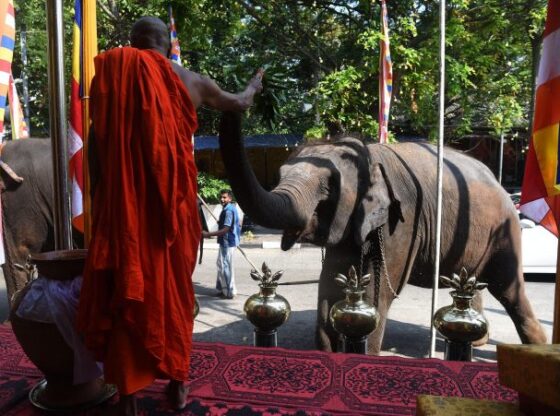

On May 7, Sri Lanka’s Supreme Court delivered a ruling that reverberates far beyond the island nation’s borders: a Buddhist head monk was found to have violated both conservation laws and Buddhist principles by leasing temple lands for development that devastated local ecosystems and disrupted migratory elephant herds. The court declared that harming nature in this manner is not only illegal under Sri Lankan law but fundamentally contrary to Buddhism itself—a religion the state is constitutionally bound to protect. This landmark decision forces a reckoning with how spiritual authority and environmental stewardship intersect, and whether they can ever truly be separated.
For decades, Buddhist monasteries in Sri Lanka have held vast tracts of land, often donated by kings and devotees seeking karmic merit. Yet this ruling exposes a painful paradox: the very institutions meant to embody compassion and non-harm have sometimes become agents of ecological destruction. The head monk in question leased sacred temple grounds for commercial projects that fragmented elephant corridors and degraded forests. This is not merely a legal violation—it is a spiritual betrayal. In Buddhist cosmology, all sentient beings deserve protection, and the natural world is not a resource to be exploited but a realm of interdependence where every action ripples through the web of existence.
Prabhath Sirisena, a scholar and former forest monk, explains that forest monasteries in Sri Lanka have long demonstrated a “deep ecological ethic” binding monastics to the living world—from trees and plants to birds and elephants. Yet this ideal has always been fragile. Most monastics, historically and today, live near human settlements, relying on lay donors for support. In remote areas with sparse populations, monasteries struggle to survive, creating pressure to monetize land. This tension reveals a deeper truth: spiritual institutions are not immune to worldly compromises. The forest monk tradition, which embodies harmony with nature, has always been rare, and the majority of monastics face the same economic pressures as any landowner.
The ruling also raises an uncomfortable question for Buddhists worldwide: What happens when protecting Buddhism and protecting nature pull in opposite directions? The Esala Perahera procession in Kandy, where captive elephants in leg chains carry sacred relics, stands as a stark example. The court’s confident equation of Buddhism with environmentalism may be legally sound, but it glosses over centuries of tradition where animals have been used for religious purposes. For the seeker of wisdom, the takeaway is profound: spiritual teachings must be lived, not merely invoked. True dharma practice extends beyond meditation cushions and temple walls—it demands accountability for how we treat the earth and all its creatures. The elephants in the courtroom are not just a legal case; they are a mirror reflecting whether our faith can rise to its own highest principles.