
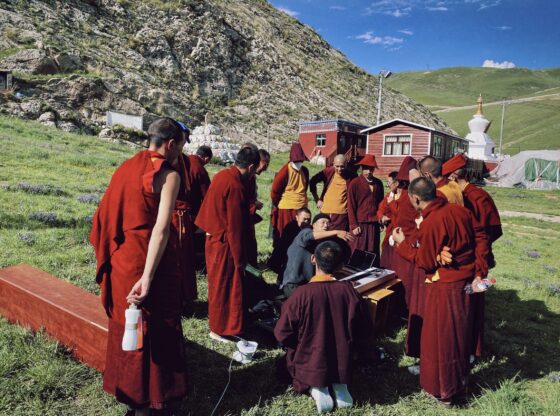

When Sound Becomes Prayer: How Electronic Music Meets Vajrayana
In the urban sprawl of Paris, far from the Tibetan peaks where he recorded his latest album, Chinese electronic musician Howie Lee offers a startlingly simple thesis: “Consciousness is the only valuable thing. Money is not.” His work, recorded at Drolma Wesel-Ling Monastery in northeastern Tibet, represents more than a genre experiment—it is a sonic meditation on the nature of reality itself.
Lee’s journey began with philosophical curiosity about the Heart Sutra, whose assertion that “nothing is solid” resonated with his digital craft. But the pandemic brought an unexpected invitation from photographer Nyema to visit the monastery, a meeting Lee describes as “sort of magic.” There, Vajrayana mantras transformed his artistic self-understanding.
“Buddhist teachings are like, you open a little narrow door, then you look inside,” Lee reflects. “There is always so much you find. Then you go, you become, but in the end, you figure out there’s actually no new knowledge gained. You’ve already had the knowledge all along.” This echoes the doctrine of buddha-nature—that spiritual practice is less about acquisition than unlearning, peeling away obstructions to reveal the innate luminosity of consciousness already present within.
For seekers, Lee’s work offers a contemporary gateway: electronic frequencies as modern prayer wheels, spinning ancient syllables into the digital ether.