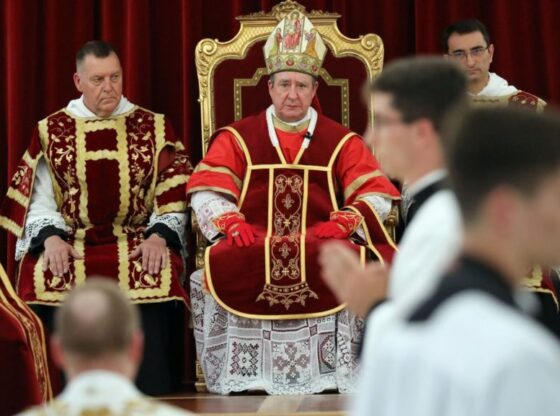

The Vatican’s recent declaration that the Society of St. Pius X (SSPX) is “in schism” after the unauthorized consecration of four bishops is not merely a canonical dispute—it is a spiritual earthquake that reveals the eternal tension between human tradition and divine obedience. On July 1, Bishop Alfonso de Galarreta, accompanied by Bishop Bernard Fellay, consecrated four priests as bishops at the SSPX seminary in Écône, Switzerland, without the papal mandate. The Dicastery of the Doctrine of the Faith responded the next day, declaring that the act was “schismatic” and that all six bishops—including the four newly consecrated—have incurred automatic excommunication, reserved to the Apostolic See. The decree also warned that sacraments of penance and marriage performed within the society are invalid, and that clerics and lay faithful who adhere to the schism face the same penalty.
Why does this matter spiritually? At its core, the schism is not about liturgy or doctrine, but about the nature of authority in the Church. The SSPX, founded by Archbishop Marcel Lefebvre in 1970, has long championed the traditional Latin Mass and resisted the reforms of the Second Vatican Council. Yet the Church teaches that unity with the Pope is not optional—it is the very bond that makes the Church the Body of Christ. When Lefebvre consecrated four bishops without papal approval in 1988, he was excommunicated. Now, history repeats itself, but with a deeper wound: the SSPX has chosen to sever itself from the visible head of the Church, creating a parallel hierarchy. As St. Cyprian of Carthage wrote in the third century, “He who does not hold the unity of the Church does not hold the law of God.” This act is a rejection of the Petrine ministry, which Christ Himself instituted to guard the unity of the faithful.
From the perspective of spiritual tradition, this crisis illuminates a profound lesson about the danger of absolutizing any human expression of faith. The SSPX’s attachment to the Latin Mass and pre-conciliar practices is not inherently wrong—many Catholics cherish these traditions. But when devotion to a form becomes more important than communion with the living Church, it risks becoming idolatry. The Desert Fathers warned against “the demon of noon”—the subtle temptation to mistake one’s own zeal for God’s will. St. John of the Cross taught that the soul must be detached from all things, even holy things, to be united with God. Here, the SSPX has clung so tightly to its vision of the Church that it has broken the very unity it claims to defend. As the Vatican decree states, the consecrations were performed “against the will of the Supreme Pontiff,” making the schism not a matter of conscience but of willful disobedience.
For the seeker of wisdom, the takeaway is stark but liberating: spiritual life is not about preserving the past at all costs, but about surrendering to the present guidance of the Holy Spirit, even when it challenges our preferences. The Church, like the soul, is a living organism that must grow and adapt while remaining rooted in Christ. The SSPX schism reminds us that obedience is not weakness—it is the crucible in which pride is burned away. As St. Augustine said, “The Church is a hospital for sinners, not a museum for saints.” True unity requires humility, the willingness to let go of our own plans and trust that the Spirit works through the visible Church, even when its leaders seem flawed. For those tempted to follow the SSPX into separation, the question is not whether their liturgy is beautiful, but whether their hearts are open to the full communion that Christ prayed for at the Last Supper: “That they may all be one” (John 17:21).