
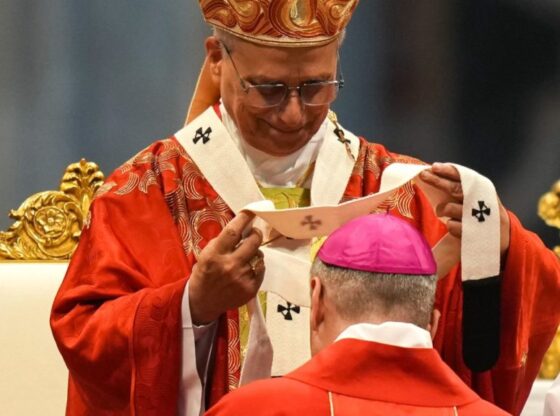

In an era when division often seems the default, Pope Leo XIV’s homily on the feast of Sts. Peter and Paul offered a radical alternative: unity built not on rigid positions, but on points of encounter in truth. Speaking during the June 29 Mass in St. Peter’s Basilica, the pope blessed the pallium—a woolen band adorned with crosses—for 35 new archbishops from 19 countries, including four from the United States.
The pallium, worn over Mass vestments, symbolizes an archbishop’s unity with the pope and his sacred duty to care for the flock. Yet Pope Leo expanded its meaning beyond hierarchy. “Communion within the Church is not built by clinging rigidly to one’s own position,” he said, “but by seeking, in all hearts, points of encounter in the truth, in whose light alone each person becomes a means of growth for another.”
This teaching echoes the lives of Peter and Paul, whom the pope called “apostles and builders of unity.” For the faithful, the lesson is clear: every Christian shares the responsibility to carry others—like lambs of the Lord’s flock—and to sacrifice energy, time, and even life so that the Gospel may bring harmony to a fractured world.