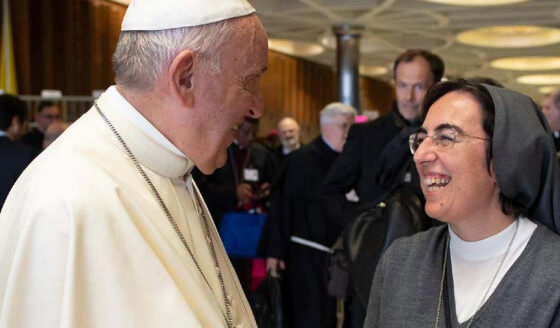

In a move that has sent ripples through the spiritual corridors of Rome, Pope Leo XIV has appointed Sister Alessandra Smerilli as the new prefect of the Dicastery for Promoting Integral Human Development. The announcement, made public today by the Holy See Press Office, marks a quiet but profound shift in the ecclesiastical landscape. Sister Smerilli, an Italian nun who previously served as secretary of the same dicastery, will assume her new role on September 1, 2026, succeeding Canadian Cardinal Michael Czerny. She now becomes the third woman in history to lead a Vatican dicastery, a milestone that speaks not merely of administrative change but of a deeper spiritual evolution.
For the seeker of wisdom, this appointment is far more than a personnel update. It is a living parable about the nature of authority in a tradition that has long wrestled with the tension between hierarchy and charism. Sister Smerilli, a member of the Daughters of Mary Help of Christians, is known not for political maneuvering but for her quiet expertise in economics and social justice. Her background resonates with the ancient monastic tradition that saw leadership not as a crown but as a service—a “diakonia” in the truest sense. In a world hungry for authentic spiritual leadership, her elevation suggests that the Church is slowly remembering that power, when stripped of ego, becomes a vessel for grace.
This event echoes a broader pattern found across the world’s wisdom traditions. In the Buddhist sangha, the Buddha insisted that his disciples lead not by title but by the example of compassion. In the Hindu tradition, the guru is one who dispels darkness, not one who commands from a throne. Sister Smerilli’s appointment mirrors this ancient principle: she is a nun, a woman who has taken vows of poverty and obedience, now entrusted with guiding a dicastery whose mission is to serve the poor and the marginalized. The spiritual significance is unmistakable—the Church is being called to lead from the margins, to let those who have washed the feet of the world now help guide its steps.
For the reader seeking a takeaway, this story offers a quiet but powerful lesson: the Holy Spirit often works through the unexpected. Sister Smerilli’s path—from a classroom teaching economics to a Vatican office shaping integral human development—reminds us that our own callings may unfold in ways we cannot predict. The appointment is not a revolution but a recalibration, a gentle nudge toward a vision of leadership rooted in humility and service. As the Atlantean Tribune has long taught, the most profound changes in the spiritual life are not the loudest but the most faithful. In Sister Smerilli, we see a mirror of our own potential to lead, not by grasping for power, but by surrendering to a purpose greater than ourselves.