
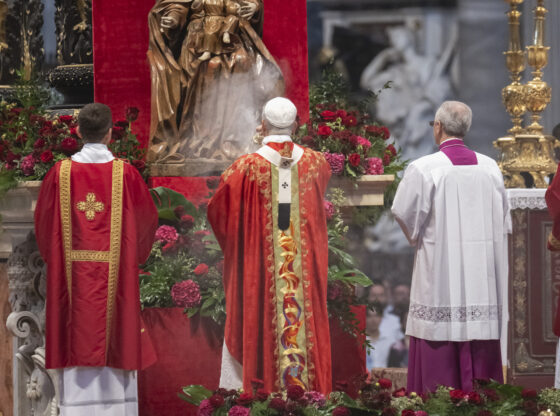

In a world fractured by division and echo chambers of opinion, the concept of unity often feels like a distant ideal—a pleasant theory rather than a lived reality. Yet on the Feast of Saints Peter and Paul, Pope Leo XIV offered a profound recalibration of what true unity demands, not as a compromise of truth, but as a sacred duty. Speaking before the world’s cardinals after two days of intense deliberations, the Pope did not offer a mere call for harmony. Instead, he held up the very lives of the Church’s two great pillars as living lessons in how unity is forged through suffering, mission, and surrender to a purpose greater than self.
At the heart of the Pope’s reflection was a startling truth: Peter and Paul did not agree on everything. They clashed, debated, and came from radically different worlds—one a fisherman from Galilee, the other a Roman-educated Pharisee. Yet their bond was not rooted in uniformity of thought, but in a shared fidelity to Christ and His mission. “They were not apostles of a doctrine,” Pope Leo XIV noted, “but apostles of unity in Christ.” This distinction is critical. In our age, unity is often mistaken for agreement; the Pope reframes it as alignment with a divine purpose that transcends personal preference or theological nuance.
Spiritually, this teaching echoes a deep current found across wisdom traditions: the idea that unity is born not from sameness, but from complementary difference held together by love. In the Eastern Orthodox tradition, this is called sobornost—a harmonious fellowship where each part retains its distinct voice while being bound to the whole. The Pope’s homily subtly invoked this principle, reminding the cardinals that the Church is not a corporation of like-minded executives, but a living body where the fisherman and the scholar, the traditionalist and the reformer, are both necessary. The unity of Peter and Paul was not a ceasefire; it was a mission. They were sent together, and that sending—that apostolic commission—became the very force that held them together when their human differences might have torn them apart.
For the reader seeking wisdom, the takeaway is both practical and profound. Unity in your own life—in your family, your community, your spiritual circle—does not require that everyone thinks as you do. It requires that everyone is moving toward the same horizon. Pope Leo XIV’s message is a quiet but firm challenge: stop waiting for others to become like you before you love them. Instead, ask yourself, “What is the mission we share?” Peter and Paul did not resolve their disagreements by one converting the other. They resolved them by both converting more deeply to Christ. That is the unbroken chain of holy unity—not a circle of identical faces, but a line of diverse souls marching together toward the same light, bound not by agreement, but by love.