
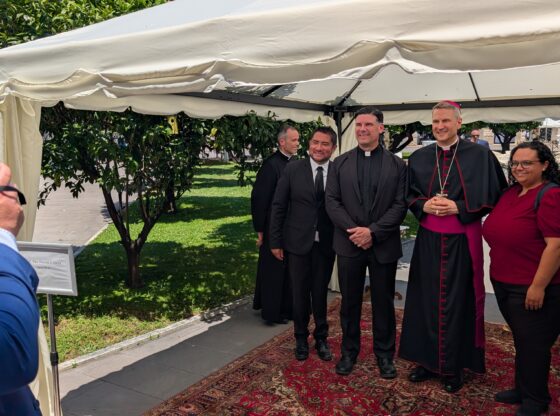

On the solemnity of Saints Peter and Paul, a scene unfolded in St. Peter’s Basilica that transcended mere ecclesiastical ceremony. Pope Leo XIV, the first American pontiff, bestowed the pallium upon 35 metropolitan archbishops, including four from the United States: Ronald Hicks of New York, James Golka of Denver, James Checchio of New Orleans, and Mark Rivituso of Mobile. For the hundreds of pilgrims who accompanied them, the event was described as “surreal”—a word that hints at the collision between earthly expectation and spiritual reality. Yet beneath the pageantry lies a deeper teaching about the nature of spiritual authority and the invisible threads that bind a global communion.
The pallium itself is no mere ornament. Woven from the wool of lambs blessed on the feast of Saint Agnes, this narrow band of white wool, marked with six black crosses, carries a weight far heavier than its material. In the ancient world, wool was the fabric of shepherds, not kings. By placing this symbol on the shoulders of a metropolitan archbishop, the Church enacts a living parable: the leader is not a master but a servant, one who carries the lost sheep back to the fold. Archbishop James Golka of Denver, visibly moved after receiving the pallium, confided that he wept upon returning to his chair. “I pray for you every day,” he told the pope. This moment of vulnerability reveals the paradox at the heart of spiritual leadership—the one who is raised up must first be broken open.
Wisdom traditions across the ages remind us that true authority is not seized but received. In the Tao Te Ching, Lao Tzu writes that the sage “does not lead by pushing, but by being in front and not blocking.” The pallium ceremony echoes this truth: the archbishop does not claim power; he receives a burden. Scott Elmer, superintendent of Catholic schools for the Archdiocese of Denver, observed the gathering with wonder: “Hearing so many languages being spoken, yet all being one in our Catholic faith.” Here is the hidden grace of such gatherings—they are not simply administrative events but living icons of a unity that transcends borders, cultures, and tongues. The diversity of voices becomes a single chorus, a foretaste of the harmony that spiritual traditions call the “peace that passes understanding.”
For the pilgrim seeking wisdom, the pallium offers a quiet but urgent lesson. In a world obsessed with self-promotion and personal branding, this ancient ritual whispers that the highest calling is to be bound to something greater than oneself. The wool on an archbishop’s shoulders is a reminder that every authentic leader is first a follower—of Christ, of tradition, of the communion of saints. As the pilgrims returned to their homes across the Atlantic, they carried not just memories of a historic Mass, but a living symbol of what it means to be woven together into a fabric that holds the world. The question each of us must ask is not whether we have received a pallium, but whether we are willing to wear the yoke of service that it represents.