
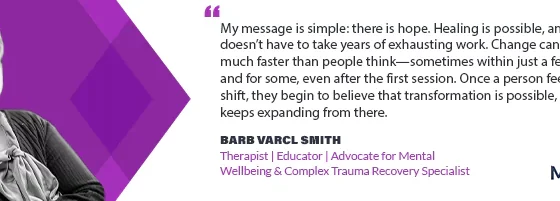

In an era where trauma is increasingly recognized as a collective wound, therapist Barb Varcl Smith has emerged as a bridge between ancient spiritual practices and contemporary psychological healing. For over three decades, Smith has been quietly revolutionizing how we understand Complex PTSD—not as a life sentence, but as an invitation to profound transformation. Her work, grounded in her own recovery from chronic fatigue syndrome, offers a roadmap that transcends conventional therapy.
Smith’s journey began with a revelation that echoes through wisdom traditions across millennia: the inseparable unity of mind and body. “The pivotal moment was the realization of the deep connection between the body and the mind—understanding that we can actually heal the body through working with the mind,” she shared. This insight, discovered through the Silva Method’s meditative practices, mirrors what the ancient Vedas called the “subtle body”—the energetic bridge between consciousness and physical form. In Buddhist psychology, this same truth appears as the understanding that mental formations directly manifest as physical sensations.
What makes Smith’s approach spiritually significant is her insistence that healing is not merely symptom management but a sacred reclamation of wholeness. Her Trauma Response Recovery program treats trauma not as a flaw but as a distortion of our natural state—a concept that resonates with the yogic idea of avidya (spiritual ignorance) clouding our true nature. “I experienced healing myself, and I saw people around me heal too,” she recalls. “That was a real ‘wow’ moment.” This testimony echoes the shamanic understanding that the healer must first walk through the fire themselves before guiding others.
The deeper context here is that Smith’s work represents a return to indigenous wisdom that modern psychology is only beginning to rediscover. Her integration of hypnosis, NLP, and cognitive approaches alongside meditative techniques mirrors what the Desert Fathers called “theoria”—contemplative knowing that transforms the whole person. In the Kabbalistic tradition, this corresponds to tikkun—the repair of what is broken through conscious intention. Smith’s clients are not merely recovering; they are remembering their original wholeness.
For the spiritual seeker, Smith’s message carries a profound takeaway: your trauma is not your identity. The very wounds that seem to define you can become the portals to your deepest healing. As she demonstrates through three decades of work, the mind’s ability to reshape the body’s experience is not wishful thinking but a spiritual technology as old as humanity itself. The question is not whether you can heal, but whether you are willing to trust the ancient wisdom that lives within your own cells—waiting to be remembered.