
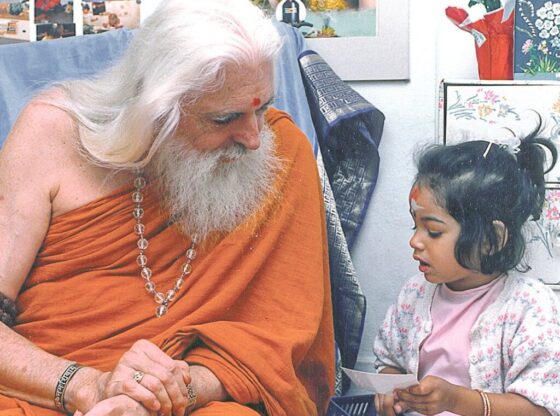

The Karmic Cost of the Rod: How One Guru Reckoned with Discipline
In the mid-1990s, a painful truth surfaced within the global Hindu community that challenged its most cherished ideals. Satguru Sivaya Subramuniyaswami (1927-2001), the founder of Hinduism Today, discovered that many of his own devoted families were striking their children as a routine form of correction. For a tradition steeped in ahimsa—non-violence—this revelation was not merely disappointing; it was a spiritual crisis.
The Guru’s response was not to condemn, but to illuminate. He dedicated the July 1998 edition of Hinduism Today to exposing the hidden trauma of corporal punishment—defined as slapping, spanking, or hitting with objects like a belt or cane. The feature story, authored by Julie Rajan, gave voice to a generation of young Hindus who carried deep resentment beneath their devotion. “We struggle with feelings of low self-esteem and failure,” Rajan wrote. “Many of us will continue the cycle of violence by beating our own children, or our spouses, simply because we are unable to resolve those feelings.”
This confession revealed a profound spiritual truth: violence against children is not a private family matter, but a karmic inheritance. The parents who struck their children were themselves victims of the same cycle, acting out of love yet trapped in ignorance. Gurudeva’s quest was not for a new parenting technique, but for a system of discipline that honored the soul of the child—one that replaced blame, shame, and pain with the sacred principle of non-injury. In doing so, he called upon Hindu families to reclaim their dharma and break the chain of suffering at its root.