
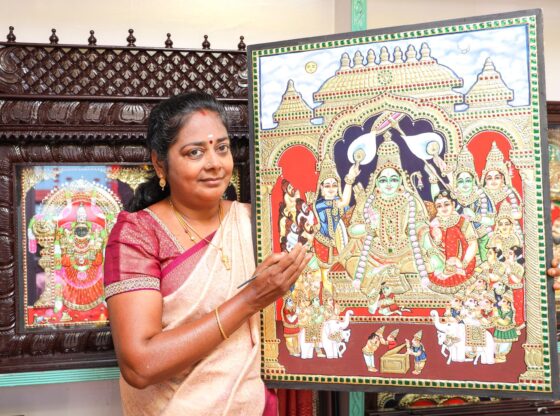

In the fertile delta of the Kaveri River, where the soil itself seems to breathe devotion, an ancient art form continues to shimmer with the light of the Divine. Thanjavur painting, known locally as palagai padam or “wooden plank picture,” is far more than a decorative craft—it is a living meditation on the sacred, a tradition where gold, gems, and devotion merge to create windows into the celestial realm. Award-winning artists Vijayalakshmi Prabhakaran and Marimuthu Uthrapathi, both honored by the state of Tamil Nadu, carry forward a lineage that has survived empires, economic shifts, and the passage of centuries.
At its core, Thanjavur painting is an act of spiritual embodiment. The process begins with a canvas stretched over a wooden board, upon which images of Deities are drawn with meticulous precision. Gold foil, crushed and applied with reverence, follows the contours of the divine forms, while precious and semi-precious stones—rubies, emeralds, sapphires, and crystals—are embedded along the lines to create depth and a bas-relief effect. This is not mere ornamentation; it is a theological statement. In Hindu wisdom, gold is eternally linked to Goddess Lakshmi, the bestower of abundance, and Lord Kubera, the treasurer of the gods. A golden Deity is considered supremely auspicious for personal worship, as the metal’s incorruptible luster mirrors the soul’s own innate purity.
The deeper significance of this art lies in its history as a vehicle for royal and temple devotion. Under the patronage of the Vijayanagara rulers, Thanjavur painting flourished as a sacred offering. When that dynasty fell, the artists—true seekers of the Divine—migrated to Thanjavur, Mysore, and Madurai, seeking not merely patrons but communities where their craft could continue to serve the sacred. The Nayaka and Maratha rulers who followed, particularly Raghunatha Nayaka (1600-1634) and Serfoji Maharaj (1777-1832), became ardent supporters. Serfoji’s devotion was so profound that artists sometimes included his likeness in Ram Darbar paintings, placing the king in the court of Lord Rama himself—a gesture that speaks to the Hindu understanding that a righteous ruler is a reflection of the Divine order.
The spiritual takeaway for the modern seeker is profound. In a world of mass production and fleeting digital images, Thanjavur painting reminds us that true art is an act of worship. Each layer of gold leaf, each embedded gem, is a prayer made visible. The tradition teaches that beauty and devotion are inseparable; that the material world, when consecrated by intention and skill, becomes a doorway to the transcendent. As artists like Vijayalakshmi and Marimuthu continue this lineage, they offer a living lesson: the Divine does not dwell in abstraction alone, but in the glittering gold of a deity’s crown, in the patient hands of the craftsman, and in the heart of the devotee who pauses to gaze upon the sacred image.