
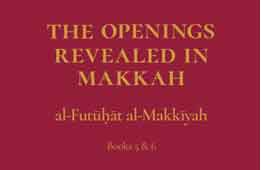

On June 23, 2021, Pir Press released Volume 3 of The Openings Revealed in Makkah, Books 5 and 6 of the English translation by Eric Winkel of Ibn Arabi’s monumental work, al-Futuhat al-Makkiyah. This volume continues the slow, painstaking unveiling of a text that has shaped Islamic spirituality for over seven centuries. While the source quietly notes a publication event, the spiritual significance of this translation cannot be overstated—it is a bridge between a medieval mystic’s vision and the seeker of today, offering direct access to teachings that have long been guarded by language and time.
Why does this matter spiritually? Ibn Arabi’s Futuhat is not merely a book; it is a map of the soul’s journey toward the Divine. Written during his stay in Makkah, the very heart of Islamic pilgrimage, the work emerged from a state of spiritual unveiling (kashf) that Ibn Arabi himself described as a direct encounter with the Real. Each chapter, or “opening,” corresponds to a station (maqam) on the path of spiritual realization. By making these openings accessible in English, Winkel’s translation invites contemporary seekers to walk the same path, to taste the same unveilings, and to discover that the spiritual realities Ibn Arabi wrote about are not historical artifacts but living truths available to anyone who seeks with sincerity.
Deeper context from wisdom traditions reveals that Ibn Arabi’s work is a synthesis of the entire Islamic spiritual heritage, drawing from the Quran, the Hadith, and the insights of earlier Sufi masters. The Futuhat is often called the “mother of all books” in Sufi circles because it encompasses every major theme of Islamic mysticism: the nature of divine unity (tawhid), the station of the Perfect Human (al-insan al-kamil), the cosmogony of creation, and the path of spiritual ascent. In Volume 3, Books 5 and 6 delve into the mysteries of divine names and attributes, teaching that the seeker’s journey is one of transformation through the realization that all existence is a reflection of the One. As Ibn Arabi wrote, “The cosmos is a book of signs, and the human being is its reader.” This translation reopens that book for a new generation.
The takeaway for the reader is profound: spiritual knowledge is not a passive inheritance but an active unveiling. The publication of this volume is a reminder that the quest for divine reality requires patience, dedication, and a willingness to engage with teachings that challenge the ego’s limitations. Ibn Arabi’s Openings are not meant to be read as mere information; they are meant to be lived, meditated upon, and realized. For the seeker today, this translation offers a rare opportunity to sit at the feet of a master, to hear his words in a language that speaks to the heart, and to begin the journey of one’s own openings. The door is open—the question is whether we will step through.