
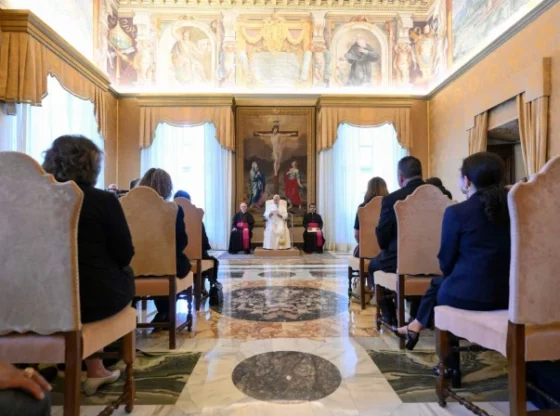

In a private audience on June 25, Pope Leo XIV addressed representatives of North American Jesuit colleges and universities, offering not a mere pep talk but a spiritual roadmap for navigating what he called an “epochal change” sweeping across human civilization. The meeting, held at the Vatican, came at a time when many Catholic institutions find themselves caught between secular pressures and their own foundational mission. Rather than prescribing administrative fixes, the pontiff pointed to four ancient yet urgent priorities that have guided the Society of Jesus since 2019—the Universal Apostolic Preferences—as a compass for these turbulent times.
The Holy Father did not mince words about the scale of the crisis. He identified secularization as a force that is “seeking to push any mention of God out of the public sphere and beyond popular culture,” alongside the failure of political systems to serve migrants and the marginalized, the erosion of hope among young people, environmental degradation, and the rise of artificial intelligence. For spiritual seekers, this litany of challenges reveals a deeper truth: the modern world is experiencing a collective disorientation precisely because it has severed its connection to the transcendent. The fragmentation of society, the pope implied, is ultimately a fragmentation of the soul.
At the heart of Leo XIV’s address was a call to return to the Spiritual Exercises of St. Ignatius of Loyola, the foundational practice of Jesuit spirituality. He urged academic communities to offer these exercises, saying that “those who conduct research, those who pursue studies and those who seek the truth are ultimately seeking God, whether they realize it or not.” This insight resonates across wisdom traditions: the contemplative path is not an escape from the world but the very ground of clear seeing. In a culture addicted to speed and surface, the discipline of discernment—learning to recognize the movements of the Spirit—becomes a revolutionary act. The pope’s message suggests that the deepest response to secularization is not louder argument but deeper prayer.
The four Universal Apostolic Preferences—showing the way to God through discernment, walking with the poor and excluded, accompanying young people toward a hope-filled future, and caring for our common home—form a coherent spiritual ecology. They remind us that no single issue can be addressed in isolation. The “thirst for God” that the pope observed among young people is inseparable from the cry of the earth and the groaning of the marginalized. For readers seeking wisdom, the takeaway is clear: authentic spiritual life cannot be privatized. It must engage the full catastrophe of our time—political failure, ecological collapse, technological disruption—not with fear, but with the confidence that the One who is Truth is already present in every search, every struggle, and every act of compassion.