
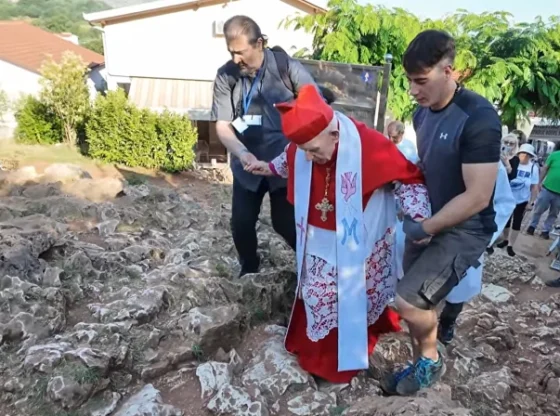

On June 23, 2025, Cardinal Ernest Simoni, a 97-year-old survivor of Albania’s brutal communist regime, climbed the rocky slopes of Apparition Hill in Medjugorje. Assisted by young members of the Cenacolo Community—who carried him partway on a litter—the elderly cardinal traversed the path on foot where he could, blessing the crowd and praying the rosary at the summit. The pilgrimage came one day before the 45th anniversary of the first reported apparitions of the Virgin Mary in this Bosnian village, a site that has drawn millions of seekers since 1981.
This act of devotion carries profound spiritual weight. Cardinal Simoni was twice sentenced to death under Enver Hoxha, the dictator who declared Albania “the first atheist state in the world.” As a young priest, he endured torture and 28 years of forced labor in coal mines, yet never renounced his faith. His climb up Apparition Hill is not merely a physical feat—it is a living parable. The mountain, with its sharp stones and steep incline, mirrors the path of suffering he walked for decades. That he, at 97, would choose to ascend it on the eve of the anniversary suggests that the same grace that sustained him in prison still animates his bones.
From the perspective of wisdom traditions, this event echoes the ancient pattern of the “dark night of the soul”—a period of purgation that purifies faith. The communist regime sought to erase God from Albania, yet here stands a man who was buried alive in its mines, now blessing water at a site of reported heavenly visitation. The Dicastery for the Doctrine of the Faith, in its 2024 document The Queen of Peace, acknowledged the spiritual fruits of Medjugorje without pronouncing on the supernatural nature of the apparitions. Cardinal Simoni’s presence adds a different kind of testimony: not of visions, but of fidelity. His life suggests that the true miracle may not be the Virgin’s appearance on a hill, but the resilience of a soul that refuses to let hatred or pain extinguish its love.
For the reader seeking wisdom, the cardinal’s climb offers a quiet challenge. Most of us will never face torture or forced labor. Yet we all have our own Apparition Hills—places of difficulty we are called to ascend despite exhaustion. The cardinal did not walk the entire path alone; he accepted help from the young, allowing himself to be carried when his strength failed. This humility, born of a life stripped of pride, is perhaps the deepest lesson. Spiritual growth does not demand that we conquer every peak unaided. It asks only that we keep moving upward, even when we must be borne by others. As Cardinal Simoni blessed the crowd with water at the summit, he reminded us that the water of faith, once it has passed through the rock of suffering, becomes a gift for all who thirst.