
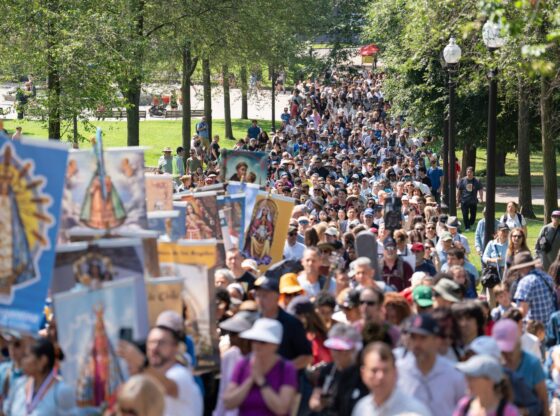

On a sun-drenched Saturday in Boston, a procession of nearly 3,000 faithful transformed the city’s historic Freedom Trail into a living prayer. The National Eucharistic Pilgrimage, which began its East Coast journey on May 24 in St. Augustine, Florida, reached its most powerful moment yet as the Blessed Sacrament was carried through streets once walked by revolutionaries. The two-hour-and-fifteen-minute march wove past sites of the American Revolution, but Archbishop Richard Henning declared that this day would “make history” as the first time the trail was walked as “the people of God, led by our Lord and savior, Jesus Christ.”
The spiritual significance of this event reaches beyond a single afternoon. When the Eucharist—what Catholics believe is the real presence of Jesus Christ—moves through public space, it reclaims territory often surrendered to the secular. Jason Shanks, president of the National Eucharistic Congress, noted that the Boston crowd was the largest since the pilgrimage began, saying, “It was a beautiful moment to see the people of God sort of show up for Jesus, and you could really hear their voices.” This public witness echoes ancient Christian practices where faith was never confined to buildings but pulsed through marketplaces and city gates.
Wisdom traditions across history affirm that sacred presence sanctifies ground. The Hebrew Scriptures describe how the Ark of the Covenant, carried through the wilderness, made ordinary soil holy. In Catholic theology, the Eucharist extends this principle: Christ walks among us still. The presence of Polish, Latino, Vietnamese, and Cape Verdean groups leading hymns and prayers demonstrated that this was not a narrow devotion but a universal longing. Archbishop Henning observed that whenever he turned around, “I could never see the end of it in the back”—a reminder that the spiritual journey has no visible boundary.
For the seeker of wisdom, this event offers a profound takeaway: holiness is not static. It moves, it processes, it claims space. The Freedom Trail, originally marked in red paint and brick to guide tourists, became for one morning a path of pilgrimage. Every street, every sidewalk, every ordinary place holds the potential for encounter with the divine. The question is not whether God is present, but whether we will follow—and whether we will let our voices be heard above the noise of a distracted world.