
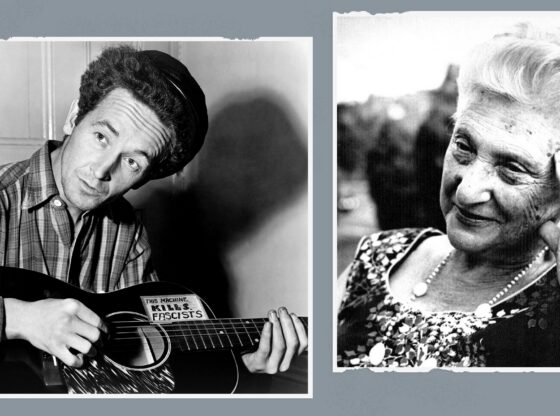

When the Dust Bowl Met the Shtetl: What Woody Guthrie’s Jewish Roots Teach Us About Sacred Song
In the vast tapestry of American spiritual music, few threads connect more unexpectedly than the bond between Oklahoma’s dust-scoured plains and the Yiddish poetry of Jewish immigrants. Steven Pressman’s documentary “Dust Bowls and Jewish Souls” reveals that Woody Guthrie’s creative soul was profoundly shaped not merely by Christian folk traditions, but by the living Judaism of his second wife’s family.
This is not a story of conversion or appropriation, but of holy resonance. Guthrie found in the Jewish experience of exile and wandering a mirror to his own Dust Bowl refugees. His mother-in-law, Aliza Greenblatt, a Yiddish poet and Zionist leader, became a spiritual mentor whose lyrical sensibilities seeped into Guthrie’s songwriting. Their relationship demonstrates how authentic interfaith encounter can birth new expressions of the sacred.
When Guthrie wrote Hanukkah songs, he was not performing cultural tourism. He was participating in a tradition that understands song as prayer, and memory as obligation. His “This Land Is Your Land” carries echoes of prophetic justice—the biblical demand that land be shared, that no one be turned away. In this light, Guthrie’s folk canon becomes a testament to how divine truth speaks through multiple tongues, uniting the stranger and the citizen in one melody.