
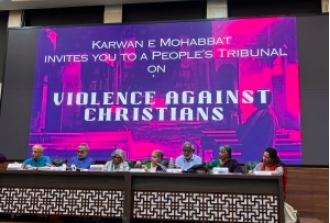

A public hearing in India has laid bare a troubling dimension of religious persecution that extends beyond the violence itself: the perceived silence of church leadership. Bishops, cardinals, and archbishops were openly accused by grassroots Christian communities of failing to stand with ordinary believers suffering systemic attacks in their neighborhoods. The hearing, convened by Christian advocacy groups, gathered testimonies from victims of anti-Christian violence across multiple states, revealing a pattern of intimidation, property destruction, and physical assault that has intensified in recent years.
The spiritual significance of these accusations cuts to the heart of what it means to be a faith community under duress. In Christian tradition, the shepherd is called to lay down his life for the sheep, yet here we find the flock crying out that their shepherds are distant, perhaps even afraid. This is not merely a political or institutional failure—it is a crisis of witness. The early church fathers taught that martyrdom, whether through blood or through daily faithfulness, is the seed of the church. When leaders withdraw from the suffering of their people, they risk severing the very connection that gives the church its power to transform persecution into testimony.
Across wisdom traditions, the theme of leadership in times of trial is a recurring thread. In the Hebrew scriptures, prophets like Jeremiah stood with the people even as they were dragged into exile. In the Buddhist tradition, the Bodhisattva vows to delay their own liberation until all beings are freed. The Hindu concept of dharma demands that those in positions of authority protect the vulnerable, not merely from a distance but through embodied presence. The accusation at this hearing is therefore not just about policy or advocacy—it is about the spiritual substance of leadership itself. When the powerful remain silent, the powerless are left to wonder whether their suffering is seen, and whether their faith is shared by those who claim to guide them.
For the reader seeking wisdom, the takeaway is twofold. First, this hearing reminds us that spiritual authority is not a privilege but a burden—and that burden is measured by one’s willingness to stand in the fire with those who are burning. Second, it calls each of us to examine our own circles of concern. Are we present to the suffering of our neighbors, or do we offer prayers from a safe distance? The early Christian writer Tertullian observed that “the blood of the martyrs is the seed of the church.” But that seed cannot take root if the soil is abandoned by those who are called to till it. In the end, the question posed by this hearing is not only for bishops in India but for every soul that claims to follow the Way: When violence comes, will we stand together, or will we stand apart?