
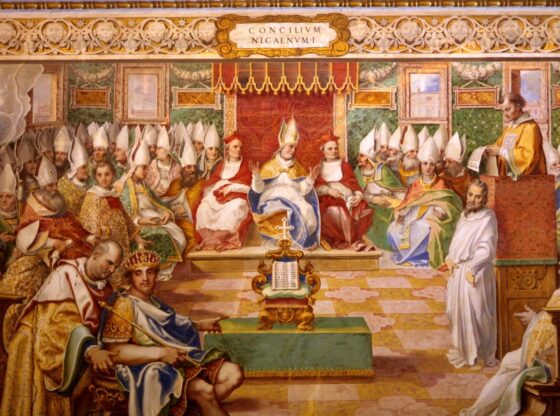

When Memory Fades: Theodoret’s Witness to the Faith of Nicaea
In an age where digital records vanish with a single click, the ancient historian Theodoret of Cyrrhus understood a timeless truth: memory requires deliberate preservation. Writing between 393 and 457 AD, Theodoret opened his Ecclesiastical History with a striking metaphor—comparing historians to painters who “delight the eye” but warning that “the painter’s art is ruined by time.” His solution was to trade panels for pages, pigments for prose, ensuring that noble deeds would not be lost to oblivion.
Theodoret’s work remains one of our most vital windows into the Council of Nicaea, where the Church wrestled with the deepest questions of Christ’s nature. He wrote not from detached curiosity but from conviction, acknowledging his own inadequacy while “trusting in the bounty of the Giver of all good.” Modern historians like Gibbon ranked Theodoret alongside Socrates and Sozomen as a reliable witness, but his value transcends academic interest. He reminds us that the Nicene Creed is not merely a document—it is a living testimony passed through generations who refused to let the faith fade. In preserving their witness, Theodoret calls us to become custodians of memory ourselves.