
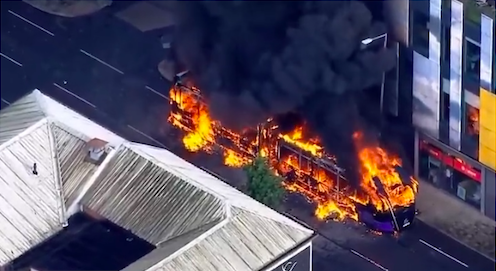

In the wake of a brutal knife attack that shattered the peace of a Belfast neighborhood on Tuesday, the Most Reverend John McDowell, Archbishop of Armagh, has issued a powerful plea for calm. The incident, which left one man hospitalized with serious injuries, has reignited fears of communal unrest in a region where the scars of sectarian conflict remain tender. Yet the Archbishop’s response, rooted in ancient spiritual wisdom, offers a path not of retaliation but of collective stillness—a counterintuitive remedy in a world quick to demand vengeance.
The archbishop’s appeal transcends mere political diplomacy. It echoes a profound spiritual truth found across wisdom traditions: that violence, once unleashed, creates a vortex of fear and anger that can only be broken by conscious restraint. “Let us not allow this act to define who we are,” McDowell urged, calling on communities to “refuse to be drawn into a cycle of recrimination.” This is not passivity but a disciplined act of spiritual warfare—a refusal to let darkness multiply darkness. In Christian teaching, this mirrors Christ’s own command to turn the other cheek, not as weakness but as a radical assertion of a higher law.
Historically, Northern Ireland’s Troubles taught a grim lesson: that every act of violence begets another, spiraling into generations of pain. The Archbishop’s words invoke the wisdom of peacemakers like John Hume and the Corrymeela Community, who understood that true reconciliation requires the courage to absorb hurt without passing it on. In Buddhist philosophy, this is akin to the practice of “holding space” for suffering without reacting—a spiritual discipline that transforms victims into vessels of grace. The attack is a test, not of strength in arms, but of the depth of our commitment to love.
For the seeker of spiritual wisdom, this moment offers a stark mirror. When faced with injustice, the soul’s first instinct may be to strike back, to demand retribution. Yet the Archbishop’s call invites us to a deeper practice: the cultivation of inner peace as a bulwark against chaos. “Our strength lies in our unity and our refusal to be divided,” he said. This is the essence of the spiritual life—to become so rooted in the Divine that no external storm can shake our commitment to compassion. In every crisis, we are given a choice: to feed the fire or to be the water.
The takeaway for the reader is both simple and demanding: the next time anger rises in response to injustice, pause. Breathe. Remember that the greatest spiritual victories are won not in the streets but in the silence of the heart. As the Archbishop’s words remind us, peace is not the absence of conflict but the presence of a love so fierce it refuses to be extinguished by hatred. In Belfast, and in our own lives, the sacred call is the same: choose stillness, and let that be the seed of a new world.