
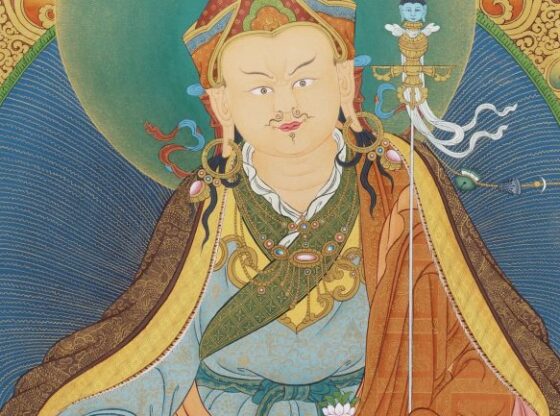

The Lotus-Born Teacher: What Padmasambhava Reveals About Confronting Inner Demons
In an age of political turmoil, one meditator sat chanting the mantra of Padmasambhava at a pro-Democracy rally, transforming a space of protest into a field of spiritual practice. The choice of mantra—Oṃ Āḥ Hūṃ Vajra Guru Padma Siddhi Hūṃ—was no accident. It invokes Guru Rinpoche, the “Precious Teacher” of 8th- and 9th-century Tibet, whose legends speak not of political victory but of taming the chaotic forces of mind.
Padmasambhava, whose name means “born from a lotus,” is said to have emerged fully formed as an eight-year-old boy from a lotus on Lake Danakosha. He converted Tibet to Buddhism and founded the Nyingmapa school. But his deeper teaching lies in his mythic battles with local spirits and demons—whom he did not destroy, but converted into protectors of the Dharma. This act reveals a profound spiritual truth: the path to liberation is not about defeating external enemies, but learning the secret names of one’s own inner demons.
As the meditator chanted amid hecklers shouting “You’re all criminals!” the mantra became a weapon not of aggression, but of transformation. Padmasambhava’s legend reminds us that every hostile force, whether in the world or within the heart, can be met with compassion and reclaimed as an ally on the journey to awakening.