
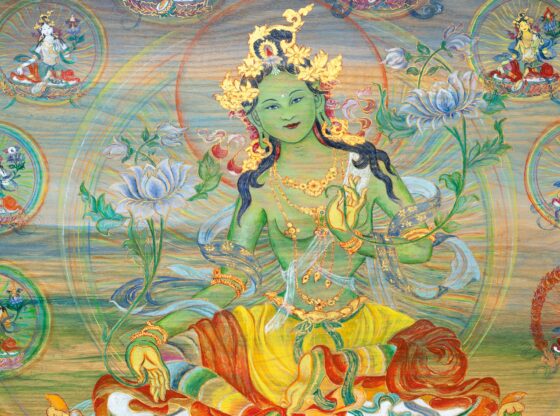

The Alchemy of Adversity: How Tara’s Twenty-One Forms Transform Obstacles into Awakening
In a spiritual landscape often focused on escaping suffering, the Vajrayana tradition offers a radical alternative: not the removal of difficulty, but a transformation of our relationship to it. This teaching, embodied in the female buddha Tara, suggests that what we perceive as blockage can become the very ground of liberation. The Praises to the Twenty-One Taras, an ancient liturgy, maps this inner alchemy through a progression of emanations, each revealing a distinct facet of awakened compassion.
Green Tara stands as the central figure, the source from which all twenty-one forms arise. These emanations are not separate deities but a living cartography of how enlightened qualities unfold in human experience. The final seven Taras—numbers fifteen through twenty-one—represent the culmination of this journey, where the practitioner moves beyond mere protection and restoration into a state of profound integration. Here, the capacity to embrace difficulty is no longer an effort but a natural expression of wisdom.
“Through practice,” the tradition teaches, “these qualities begin to shape how we see, relate, and respond to the world, becoming the basis for wise discernment, compassionate engagement, and courageous action.” Tara, whose name means “she who liberates,” does not promise a life without obstacles. Instead, she reveals that each challenge, when met with the heart’s full presence, becomes a doorway to the peace that is already, always, our true nature.