Sacred Arts 2026: How Contemporary Artists Are Rediscovering the Spiritual Through Clay, Ritual, and Material
In an era defined by digital saturation and artificial intelligence, a quiet but powerful counter-movement is taking shape in the world's galleries and studios. Artists from London to Lagos are turning away from screens and returning to the elemental — clay, earth, fire, and water — as conduits for spiritual expression. Two landmark events this summer, the Sacred Arts 2026 conference at the University of Oxford and the Ranti Bam solo exhibition 'Sacred Groves' at the South London Gallery, are drawing unprecedented attention to the ancient but rejuvenated intersection of art and the sacred.
The Sacred Arts 2026 conference, hosted by the London Arts-Based Research Centre at Oxford on May 16-17, brought together researchers, postgraduate students, and practicing creatives from across the globe to examine the role of religious artefacts and rituals in shaping human perception of the divine. The conference posed fundamental questions: How do religious artefacts shape our understanding of the transcendent? What ekphrastic responses arise between different mediums of religious art? And what can archaeological findings tell us about the sacred in the human psyche?
Presenters explored the full spectrum of sacred material culture — from Byzantine iconography and Jewish ceremonial objects to Sufi calligraphy and Indigenous Australian songlines. The transdisciplinary format allowed ceramicists to share panels with theologians, and film-makers to exchange ideas with archaeologists. A recurring theme was that matter itself — clay, stone, pigment, thread — carries spiritual memory, and that contemporary artists are increasingly drawing on this understanding to create works that function less as commodities and more as sites of contemplation.
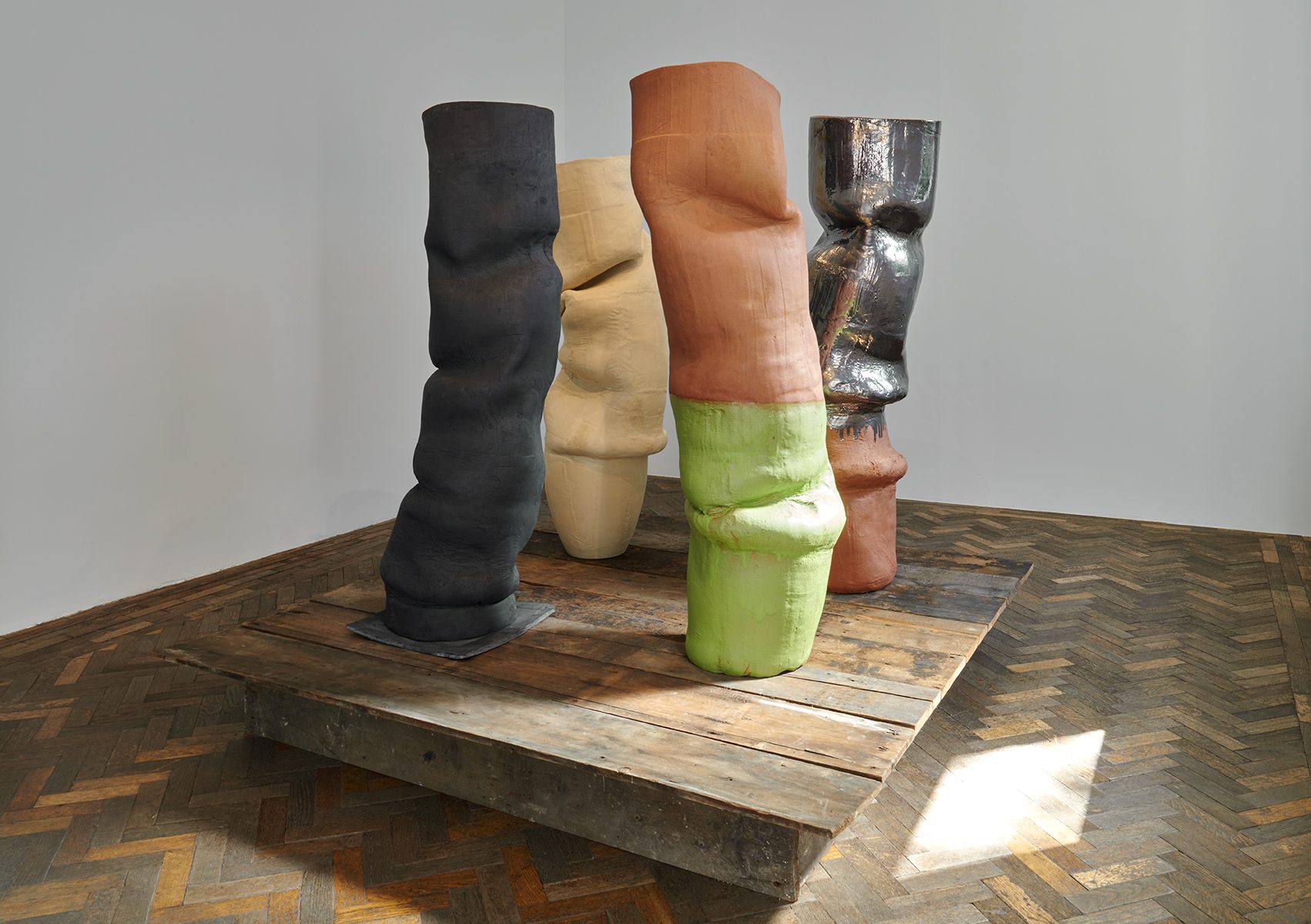
Running parallel to the Oxford conference, the South London Gallery is presenting 'Sacred Groves,' the first solo institutional exhibition by British Nigerian artist Ranti Bam. The show, which opened in May and runs through August 23, marks a significant moment in the recognition of spiritually engaged contemporary art. Bam works across sculpture, performance, film, and photography, but her ceramic practice forms the emotional and intellectual heart of the exhibition.
Bam's sculptures are divided into two interconnected series: the Ifas and the Abstract Vessels. The Ifas are large stoneware works created by embracing wet clay directly against her body, allowing the material to collapse, crack, and fold under its own weight. The process is deliberately intimate and physically demanding. Bam has described how this tactile connection with raw clay makes her feel more spiritually grounded — a form of prayer made manifest through the hands rather than words.
The Abstract Vessels, meanwhile, are covered in intricate patterns and colours inspired by textiles and Yoruba language. Bam pierces the surface by hand, revealing layers of glaze within. The entire process — rolling, puncturing, glazing, firing — engages all four classical elements: earth in the clay, air in the drying process, fire in the kiln, and water in the glazes. For Bam, this elemental cycle mirrors the spiritual journey of transformation and renewal.
A highlight of the exhibition is a new film produced at Osun-Osogbo, the sacred grove of the Yoruba fertility goddess Osun in Nigeria. The film traces the river's path through the landscape, documenting both the beauty of the sacred site and the environmental pressures it faces from human activity. It is a meditation on the fragility of sacred spaces in the modern world.
The timing of these events is no coincidence. There is a growing hunger for art that does more than decorate or provoke — art that heals, connects, and re-enchants a world that many feel has grown spiritually arid. Museums from the British Museum to the Vatican Museums have reported rising visitor numbers for their sacred art collections, while younger collectors are increasingly drawn to works with explicit spiritual or ritual dimensions.
Bam's trajectory reflects this cultural shift. In June 2026, she will unveil a permanent public artwork for Climate Clock, curated by Alice Sharp for Oulu26 in Finland, the European Capital of Culture. She has also been invited to participate in the 61st International Art Exhibition of La Biennale di Venezia by curator Koyo Kouoh — one of the highest honours in the contemporary art world.
The Sacred Arts 2026 conference and the 'Sacred Groves' exhibition are not isolated phenomena. They are signals of a deeper cultural realignment — a recognition that art, at its most potent, has always been a form of spiritual technology. As the digital world accelerates, these artists remind us that the most profound connections are still forged through the oldest materials of all: earth, fire, water, and the human hand.
#SacredArts #RantiBam #ContemporarySpirituality #ArtAndRitual #SacredGroves #SpiritualArt #MaterialCulture