
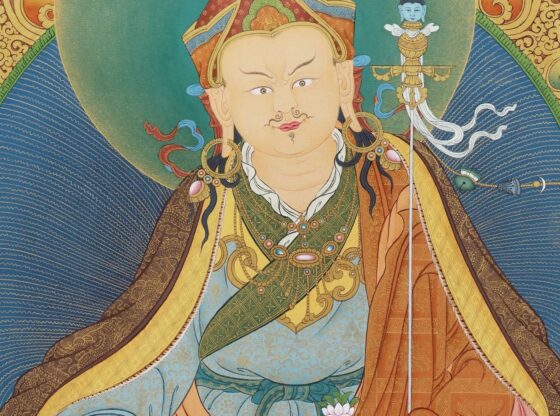

In a powerful act of spiritual witness, one Buddhist practitioner recently brought ancient wisdom to a modern protest, demonstrating how the practice of naming our inner demons remains as relevant today as it was in 8th-century Tibet.
At a pro-democracy rally, a meditator sat quietly on a yoga mat, a sign reading “Buddhists For Democracy” before them. While crowds cheered and one heckler shouted, “You’re all criminals!” the practitioner chanted the mantra of Padmasambhava—Oṃ Āḥ Hūṃ Vajra Guru Padma Siddhi Hūṃ—for an entire hour.
This practice draws on the legend of Padmasambhava, or Guru Rinpoche (“Precious Teacher”), the 8th-century master who converted Tibet to Buddhism. When the Indian monk Shantarakshita first attempted to establish Buddhism there, local demons destroyed each night what was built by day. These demons, spiritual teachers explain, represent the wild, destructive forces within the Tibetan psyche—the power struggles, superstitions, and sorcery of a warlike culture.
Padmasambhava succeeded where the rational approach failed. Rather than imposing foreign teachings, he learned the demons’ secret names. By naming them, he transformed them. The demons became protectors of the dharma.
The lesson for spiritual seekers today is clear: our inner demons—anger, fear, division—cannot be ignored or suppressed. They must be met, named, and transformed through compassionate awareness. Even amid chaos, the mantra reminds us that wisdom and skillful means can convert any darkness into light.
#SpiritualNews · #FaithAndCulture · #GlobalSpirituality