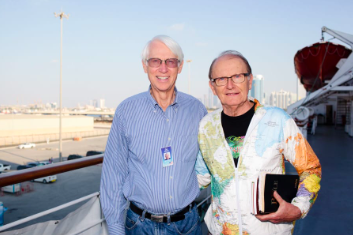

The spiritual world has lost a quiet giant. Dale Rhoton, who at the age of 88 passed from this life into the next, was not a name often shouted from pulpits or flashed across television screens. Yet his hands helped build one of the most enduring frameworks for modern Christian mission: Operation Mobilisation (OM). As tributes pour in from around the globe, we are invited not merely to remember a man, but to examine the spiritual architecture of a life poured out for the sake of the Gospel.
Rhoton, alongside George Verwer and others, co-founded OM in the late 1950s. What began as a small team distributing literature in Europe grew into a global movement of thousands. In a statement, OM International Director Lawrence Tong said, “Dale’s passion for seeing people come to know Jesus was contagious. He modeled a life of sacrifice and service that inspired generations.” This is not simply a story of organizational success; it is a testament to the spiritual principle that the Kingdom of God advances not through power, but through persistent, humble obedience. Rhoton’s life reminds us that the most profound spiritual movements often begin with a single, faithful step into the unknown.
From the perspective of wisdom traditions, Rhoton’s work echoes the ancient call of the prophet Isaiah: “Whom shall I send? And who will go for us?” (Isaiah 6:8). The co-founding of OM was a collective “yes” to that divine question, but it was also a deep embrace of the spiritual discipline of kenosis—self-emptying. Rhoton and his family lived on the front lines of faith, often lacking material comforts but rich in spiritual purpose. This is the deeper meaning of his legacy: that the structure of mission is only as strong as the prayer life of the missionary. As one long-time OM worker noted, “Dale taught us that you cannot give what you do not have. He was a man of the Word and of prayer before he was a man of action.”
For the reader seeking spiritual wisdom, Rhoton’s life offers a profound takeaway. In an age obsessed with visibility, influence, and personal brand, Dale Rhoton represents the power of hidden faithfulness. He was a co-founder, not the sole founder; a servant, not a celebrity. His life challenges us to ask: Are we building monuments to ourselves, or are we building bridges for others to find God? The true measure of a spiritual life is not the noise it makes, but the love it leaves behind. As we honor Dale Rhoton, we honor the way of the Cross—a path of quiet sacrifice that, in the end, speaks louder than any headline.