
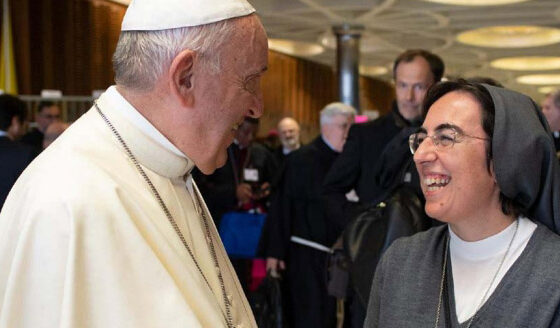

In a move that ripples through the spiritual landscape of Rome, Sister Alessandra Smerilli has been named prefect of the Dicastery for Promoting Integral Human Development, becoming the third woman to lead a major Vatican office under Pope Leo XIV. Her appointment, effective September 1, 2026, transfers authority from Canadian Cardinal Michael Czerny to the Italian nun who previously served as the dicastery’s secretary. For those who watch the signs of the times, this is not merely an administrative shift—it is a quiet revolution in how the Church embodies its deepest mission.
The spiritual significance of Sister Smerilli’s appointment transcends gender or institutional politics. To lead a dicastery dedicated to “integral human development” is to stand at the crossroads of the Gospel and the world’s suffering. Sister Smerilli, an economist by training and a Daughter of Mary Help of Christians by vocation, brings a rare synthesis: a contemplative’s depth wedded to a policy maker’s precision. Her new role places her at the heart of the Church’s social teaching, where the cry of the poor and the cry of the earth converge. In a hierarchy long associated with clerical power, her elevation signals a return to the Church’s foundational identity as servant, not master.
This appointment echoes a profound truth from the wisdom traditions: that authentic authority flows from service, not from status. The Desert Fathers taught that the elder is not the one who commands, but the one who washes the feet of others. Sister Smerilli’s journey—from a classroom teaching economics to the corridors of Vatican governance—mirrors this ancient path. St. Benedict’s Rule reminds us that the abbot “is believed to hold the place of Christ in the monastery,” a charge defined by care for the weak, not control over the strong. In appointing a woman religious to oversee integral human development, the Church reclaims this vision: leadership as a form of kenosis, of self-emptying love.
For the spiritual seeker, Sister Smerilli’s appointment offers a living parable. It whispers that the structures of religion, however rigid, can be vessels for the Spirit’s renewing breath. The dicastery she now leads—tasked with justice, peace, and ecology—is the institutional face of the Beatitudes. Her presence there invites us to reconsider where we seek authority in our own lives. Do we look to the powerful or the compassionate? Do we measure leadership by titles or by tenderness? As Sister Smerilli steps into her new role, she carries not just a portfolio but a prophecy: that the Church’s future belongs to those who serve the whole human family, especially its most fragile members. Her story is a call to each of us to locate our own dicastery of the heart—that place where we are appointed not to rule, but to love.