
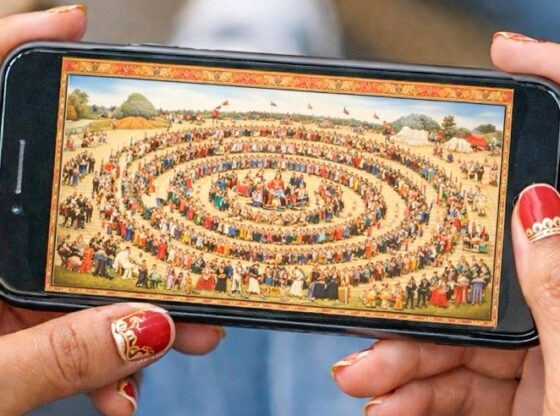

A generation of children now enters a labyrinth their ancestors could not have imagined—a digital realm that mirrors an ancient Indian war formation. Like the legendary Abhimanyu of the Mahabharata, today’s youth possess the knowledge to enter this intricate maze but lack the wisdom to escape it. Social psychologist Jonathan Haidt, in his landmark work The Anxious Generation, documents what spiritual traditions have long warned: that the soul requires balance, and when one domain dominates, the spirit suffers.
Between 2010 and 2015, childhood underwent what Haidt calls “The Great Rewiring.” Play-based childhood gave way to phone-based existence. The statistics are sobering: depression and anxiety rates among adolescents surged by over 167% among girls and 91% among boys. Emergency room visits for self-harm among teenage girls rose by 188% in the United States and United Kingdom. These numbers are not merely clinical data points—they represent souls crying out for connection in a world that has substituted screens for presence.
The Bhagavad Gita teaches that the mind is both friend and enemy—it can liberate or enslave. The Chakravyuha of the Mahabharata serves as a profound metaphor for our current crisis. Abhimanyu, the young warrior, knew the technique to breach the seven-ring battle formation but never learned the exit. He fought bravely until overwhelmed. Today’s child enters the digital realm with similar confidence: a swipe, a click, a scroll. But the exit remains hidden. The ancient sages understood that knowledge without wisdom creates bondage. The digital world offers endless information but starves the soul of the silence needed for true understanding.
The deeper spiritual crisis here is the erosion of sattvic or pure experience. Real-world play—climbing trees, building forts, chasing friends in open fields—engages the body, the senses, and the spirit in harmonious union. These activities cultivate prana, life force, and teach the soul how to navigate physical reality with joy and resilience. Screen-based existence, by contrast, feeds the rajasic and tamasic qualities: constant stimulation followed by inertia. The child who has everything except ease has lost the capacity to simply be—a capacity that all spiritual traditions identify as the foundation of inner peace.
For the reader seeking wisdom, this moment calls for a return to ancient principles. The Upanishads remind us that the Self is not found in external objects but in the stillness within. Parents and teachers must become guides who teach not only how to enter the digital world but how to leave it. Create sacred spaces without screens. Reintroduce unstructured play in nature. Teach children the art of dhyana, meditation, as a counterbalance to digital noise. The Chakravyuha of our age can be escaped, but only by rediscovering the timeless truth that the soul thrives not in constant stimulation, but in the quiet spaces between. The real battle is not against technology—it is for the soul of the next generation.