
An “Imperfect Vessel” at the Altar: What One Bishop’s Consecration Reveals About Interfaith Inheritance
The Episcopal Church’s 237-year history reached a new threshold this month when Adam J. Shoemaker was consecrated as the first bishop of Arab and North African descent. But the spiritual significance of his elevation runs deeper than a first.
Shoemaker, 47, is the son of a Muslim Egyptian father and a New Yorker with Jewish roots — a personal map of the Abrahamic traditions. Baptized in the diocese he now leads, he has lived in Latin America and speaks Portuguese and Spanish, serving one of the church’s most ethnically diverse regions.
He describes himself not as an icon but as an “imperfect vessel.”
“He embodies what it means to be the church in the world, and in particular, in New York City and the suburbs,” said the Rev. Lindsay Lunnum, rector of Zion Episcopal Church in Queens.
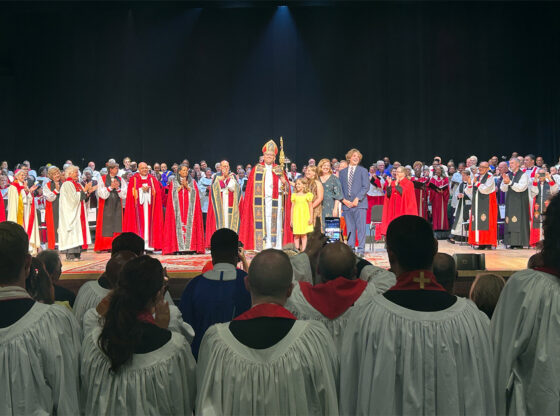
Nearly 2,000 people attended the ceremony at Tilles Center for the Performing Arts, where Shoemaker wore vestments bearing a Turkish blue tulip and North African pattern. The line to greet him stretched beyond 90 minutes — a quiet testament to what happens when a faith tradition finally sees its own diversity reflected at the altar.