
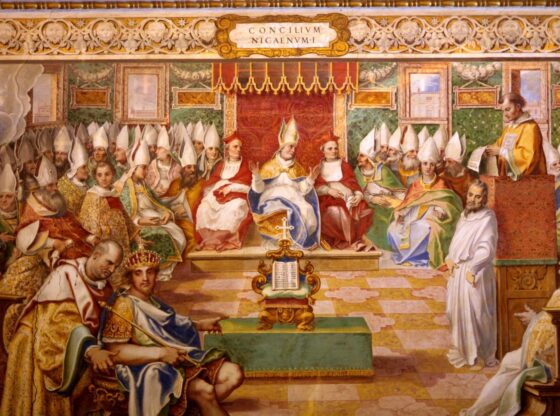

The Council That Refused to Fade: How Nicaea’s Witness Outlasted Empires
History is a fragile canvas. Theodoret of Cyrrhus understood this intimately, comparing the fading pigments of ancient paintings to the slow erosion of collective memory. His fifth-century Ecclesiastical History was not merely a record—it was an act of spiritual preservation, a deliberate effort to keep alive the deeds of those who had “lived and died in the Faith.”
At the heart of his account stands the Council of Nicaea, a gathering that transcended political maneuvering to become a defining moment in Christian self-understanding. Theodoret’s urgency reminds us that theological clarity is never achieved once and for all; it must be remembered, retold, and reclaimed by each generation. His humility—”I shrink from attempting it”—reflects a deeper truth: the task of bearing witness is always undertaken in dependence on divine grace, not human competence.
What Nicaea reveals is not merely a historical event but a pattern of faithfulness. When communities face fragmentation, they are called to gather, to deliberate, and to articulate what they believe. The creed that emerged was not a novelty but a distillation—a declaration that the Church’s memory of Christ could not be surrendered to the tides of cultural pressure.
Theodoret’s labor invites us to consider our own stewardship of sacred memory. In an age of distraction, who will paint the panels of our spiritual inheritance? The answer, perhaps, lies in trusting the “Giver of all good” to sustain the task beyond our strength.